Advertisements
Advertisements
Question
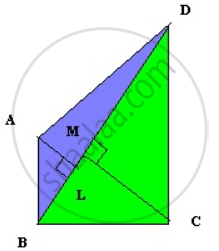
A quadrilateral field of unequal has a longer diagonal with 140m. The perpendiculars from opposite vertives upon this diagonal are 20m and 14m. Find the area of the field.
Advertisements
Solution

In quadrilateral ABCD, the sides AB, BC, CD and AD are unequal.
The longer diagonal BD = 140m
AM ⊥ BD, CL ⊥ BD
AM = 20m and CL = 14m.
We split a quadrilateral into triangles and find its area.
We know that,
Area of a Triangle = `(1)/(2)"b.h" "i.e" (1)/(2)("Base" xx "Height")`
Ar(ΔABD) = `(1)/(2)"BD" xx "AL";(Δ"CBD") = (1)/(2)"BD" xx "CM"`
Ar(QuadABCD) = Ar(ΔABD) + Ar(ΔCBD)
= `(1)/(2)"BD" xx "AL" + (1)/(2)"BD" xx "CM"`
= `(1)/(2)"BD" xx ("AL" + "CM")`
= `(1)/(2) xx 140 xx (20 + 14)`
= 70 x 34
= 2380m2.
APPEARS IN
RELATED QUESTIONS
The diagonal of a quadrilateral shaped field is 24 m and the perpendiculars dropped on it from the remaining opposite vertices are 8 m and 13 m. Find the area of the field.
The diagonal of a rectangular plot is 34 m and its perimeter is 92 m. Find its area.
The perimeter of a rectangular board is 70 cm. Taking its length as x cm, find its width in terms of x.
If the area of the rectangular board is 300 cm2; find its dimensions.
Trapezium given below; find its area.
The perimeter of a rhombus is 46 cm. If the height of the rhombus is 8 cm; find its area.
Sum of the areas of two squares is 400 cm2. If the difference of their perimeters is 16 cm, find the sides of the two squares.
Find the diagonal of a quadrilateral whose area is 756cm2 and the perpendicular from the opposite vertices are 17cm and 19cm.
Find the area of quadrilateral PQRS.

Find the value of k, if the area of a quadrilateral is 28 sq. units, whose vertices are (– 4, – 2), (– 3, k), (3, – 2) and (2, 3)
When proving that a quadrilateral is a trapezium, it is necessary to show