Advertisements
Advertisements
प्रश्न
A quadrilateral field of unequal has a longer diagonal with 140m. The perpendiculars from opposite vertives upon this diagonal are 20m and 14m. Find the area of the field.
Advertisements
उत्तर

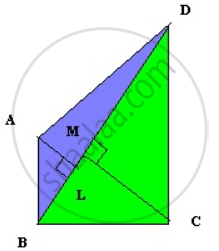
In quadrilateral ABCD, the sides AB, BC, CD and AD are unequal.
The longer diagonal BD = 140m
AM ⊥ BD, CL ⊥ BD
AM = 20m and CL = 14m.
We split a quadrilateral into triangles and find its area.
We know that,
Area of a Triangle = `(1)/(2)"b.h" "i.e" (1)/(2)("Base" xx "Height")`
Ar(ΔABD) = `(1)/(2)"BD" xx "AL";(Δ"CBD") = (1)/(2)"BD" xx "CM"`
Ar(QuadABCD) = Ar(ΔABD) + Ar(ΔCBD)
= `(1)/(2)"BD" xx "AL" + (1)/(2)"BD" xx "CM"`
= `(1)/(2)"BD" xx ("AL" + "CM")`
= `(1)/(2) xx 140 xx (20 + 14)`
= 70 x 34
= 2380m2.
APPEARS IN
संबंधित प्रश्न
A rectangular plot of land measures 45 m x 30 m. A boundary wall of height 2.4 m is built all around the plot at a distance of 1 m from the plot. Find the area of the inner surface of the boundary wall.
A rectangular plot 85 m long and 60 m broad is to be covered with grass leaving 5 m all around. Find the area to be laid with grass.
A footpath of uniform width runs all around the outside of a rectangular field 30 m long and 24 m wide. If the path occupies an area of 360 m2, find its width.
How many tiles, each of area 400 cm2, will be needed to pave a footpath which is 2 m wide and surrounds a grass plot 25 m long and 13 m wide?
The length of a rectangular verandah is 3 m more than its breadth. The numerical value of its area is equal to the numerical value of its perimeter.
(i) Taking x as the breadth of the verandah, write an equation in x that represents the above statement
(ii) Solve the equation obtained in (i) above and hence find the dimensions of the verandah.
Sum of the areas of two squares is 400 cm2. If the difference of their perimeters is 16 cm, find the sides of the two squares.
Vertices of given triangles are taken in order and their areas are provided aside. Find the value of ‘p’.
| Vertices | Area (sq.units) |
| (p, p), (5, 6), (5, –2) | 32 |
In the following, find the value of ‘a’ for which the given points are collinear
(2, 3), (4, a) and (6, – 3)
In the following, find the value of ‘a’ for which the given points are collinear
(a, 2 – 2a), (– a + 1, 2a) and (– 4 – a, 6 – 2a)
PQRS is a rectangle formed by joining the points P(– 1, – 1), Q(– 1, 4), R(5, 4) and S(5, – 1). A, B, C and D are the mid-points of PQ, QR, RS and SP respectively. Is the quadrilateral ABCD a square, a rectangle or a rhombus? Justify your answer.