Advertisements
Advertisements
प्रश्न
PQRS is a rectangle formed by joining the points P(– 1, – 1), Q(– 1, 4), R(5, 4) and S(5, – 1). A, B, C and D are the mid-points of PQ, QR, RS and SP respectively. Is the quadrilateral ABCD a square, a rectangle or a rhombus? Justify your answer.
Advertisements
उत्तर
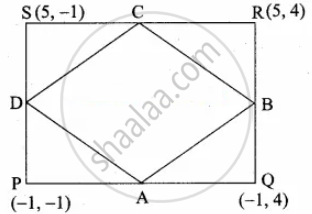
Mid point of a line = `((x_1 + x_2)/2, (y_1 + y_2)/2)`
Mid point of PQ (A) = `((-1 - 1)/2, (-1 + 4)/2)`
= `((-2)/2, 3/2)`
= `(-1, 3/2)`
Mid point of QR (B) = `((-1 + 5)/2, (4 + 4)/2) = (4/2, 8/2)` = (2, 4)
Mid point of RS (C) =`((5 + 5)/2, (4 - 1)/2) = (10/2, 3/2) = (5, 3/2)`
Mid point of PS (D) = `((5 - 1)/2, (-1 - 1)/2) = (4/2, (-2)/2)` = (2, − 1)
Distance = `sqrt((x_2 - x_1)^2 + (y_2 - y_1)^2`
AB = `sqrt((2 + 1)^2 + (4 - 3/2)^2`
= `sqrt(3^2 + (5/2)^2`
= `sqrt(9 + 25/4)`
= `sqrt((36 + 25)/4`
= `sqrt(61/4)`
BC = `sqrt((5 - 2)^2 + (3/2 - 4)^2`
= `sqrt(9 + 25/4)`
= `sqrt((36 + 25)/4`
= `sqrt(61/4)`
CD = `sqrt((5 - 2)^2 + (3/2 + 1)^2`
= `sqrt(3^2 + (5/2)^2`
= `sqrt(9 + 25/4)`
= `sqrt((36 + 25)/4)`
= `sqrt(61/4)`
AD = `sqrt((2 + 1)^2 + (-1 - 3/2)^2`
= `sqrt(3^2 + (- 5/2)^2`
= `sqrt(9 + 25/4)`
= `sqrt(61/4)`
AB = BC = CD = AD = `sqrt(61/4)`
Since all the four sides are equal,
∴ ABCD is a rhombus.
APPEARS IN
संबंधित प्रश्न
The diagonal of a rectangular plot is 34 m and its perimeter is 92 m. Find its area.
The distance between parallel sides of a trapezium is 15 cm and the length of the line segment joining the mid-points of its non-parallel sides is 26 cm. Find the area of the trapezium.
A rectangular plot of land measures 45 m x 30 m. A boundary wall of height 2.4 m is built all around the plot at a distance of 1 m from the plot. Find the area of the inner surface of the boundary wall.
The perimeter of a rectangular board is 70 cm. Taking its length as x cm, find its width in terms of x.
If the area of the rectangular board is 300 cm2; find its dimensions.
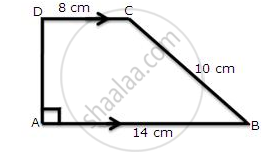
Trapezium given below; find its area.
The perimeter of a rhombus is 52 cm. If one diagonal is 24 cm; find:
(i) The length of its other diagonal,
(ii) Its area.
A floor that measures 15 m x 8 m is to be laid with tiles measuring 50 cm x 25 cm. Find the number of tiles required.
Further, if a carpet is laid on the floor so that a space of 1 m exists between its edges and the edges of the floor, what fraction of the floor is left uncovered?
Using the information in the following figure, find its area.
Vertices of given triangles are taken in order and their areas are provided aside. Find the value of ‘p’.
| Vertices | Area (sq.units) |
| (0, 0), (p, 8), (6, 2) | 20 |
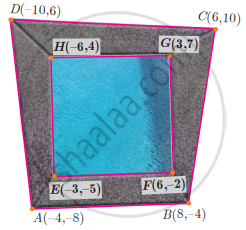
The quadrilateral swimming pool shown is surrounded by concrete patio. Find the area of the patio