हिंदी

Find the Diagonal of a Quadrilateral Whose Area is 756cm2 and the Perpendicular from the Opposite Vertices Are 17cm and 19cm. - Mathematics

Advertisements
Advertisements

प्रश्न

Find the diagonal of a quadrilateral whose area is 756cm2 and the perpendicular from the opposite vertices are 17cm and 19cm.

योग
Advertisements

उत्तर
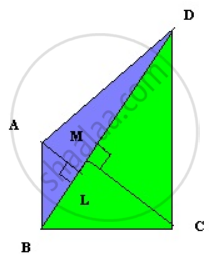

In Quadrilateral ABCD, BD is a diagonal, AM ⊥ BD, Cl ⊥ BD
AM = 17cm  and CL = 19cm and Ar(Quandrilateral ABCD) = 756cm2
Let diagonal BD = x cm
Ar(Quandrilateral ABCD)

= `(1)/(2) xx "BD"("Am" + "CL")`

⇒ 756 = `(1)/(2) xx (19 + 17)`

⇒ 756 = 18x
⇒ x = 42cm.

shaalaa.com
  क्या इस प्रश्न या उत्तर में कोई त्रुटि है?
अध्याय 24: Perimeter and Area - Exercise 24.2

APPEARS IN

फ्रैंक Mathematics [English] Class 9 ICSE
अध्याय 24 Perimeter and Area
Exercise 24.2 | Q 44

संबंधित प्रश्न

A wire when bent in the form of a square encloses an area = 576 cm2. Find the largest area enclosed by the same wire when bent to form;
(i) an equilateral triangle.
(ii) A rectangle whose adjacent sides differ by 4 cm.


A rectangular plot of land measures 45 m x 30 m. A boundary wall of height 2.4 m is built all around the plot at a distance of 1 m from the plot. Find the area of the inner surface of the boundary wall.


The length of a rectangle is twice the side of a square and its width is 6 cm greater than the side of the square. If the area of the rectangle is three times the area of the square; find the dimensions of each.


The area of a rectangular is 640 m2. Taking its length as x cm; find in terms of x, the width of the rectangle. If the perimeter of the rectangle is 104 m; find its dimensions.


A wire when bent in the form of a square encloses an area of 484 m2. Find the largest area enclosed by the same wire when bent to from:

  1. An equilateral triangle.
  2. A rectangle of length 16 m.

The length and the breadth of a rectangle are 6 cm and 4 cm respectively. Find the height of a triangle whose base is 6 cm and the area is 3 times that of the rectangle.


The figure given below shows the cross-section of a concrete structure. Calculate the area of cross-section if AB = 1.8 cm, CD = 0.6 m, DE = 0.8 m, EF = 0.3 m and AF = 1.2 m.


Two adjacent sides of a parallelogram are 24 cm and 18 cm. If the distance between the longer sides is 12 cm; find the distance between the shorter sides.


Find the area of the quadrilateral whose vertices are at (– 9, 0), (– 8, 6), (– 1, – 2) and (– 6, – 3)


The quadrilateral swimming pool shown is surrounded by concrete patio. Find the area of the patio


Share
Notifications

Englishहिंदीमराठी


      Forgot password?
Use app×