मराठी

Find the Diagonal of a Quadrilateral Whose Area is 756cm2 and the Perpendicular from the Opposite Vertices Are 17cm and 19cm. - Mathematics

Advertisements
Advertisements

प्रश्न

Find the diagonal of a quadrilateral whose area is 756cm2 and the perpendicular from the opposite vertices are 17cm and 19cm.

बेरीज
Advertisements

उत्तर
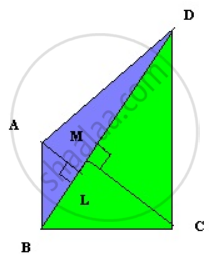

In Quadrilateral ABCD, BD is a diagonal, AM ⊥ BD, Cl ⊥ BD
AM = 17cm  and CL = 19cm and Ar(Quandrilateral ABCD) = 756cm2
Let diagonal BD = x cm
Ar(Quandrilateral ABCD)

= `(1)/(2) xx "BD"("Am" + "CL")`

⇒ 756 = `(1)/(2) xx (19 + 17)`

⇒ 756 = 18x
⇒ x = 42cm.

shaalaa.com
  या प्रश्नात किंवा उत्तरात काही त्रुटी आहे का?
पाठ 24: Perimeter and Area - Exercise 24.2

APPEARS IN

फ्रँक Mathematics [English] Class 9 ICSE
पाठ 24 Perimeter and Area
Exercise 24.2 | Q 44

संबंधित प्रश्‍न

Diagram of the adjacent picture frame has outer dimensions = 24 cm × 28 cm and inner dimensions 16 cm × 20 cm. Find the area of each section of the frame, if the width of each section is same.


The area of a parallelogram is y cm2 and its height is h cm. The base of another parallelogram is x cm more than the base of the first parallelogram and its area is twice the area of the first. Find, in terms of y, h, and x, the expression for the height of the second parallelogram.


ABCD is a square with each side 12 cm. P is a point on BC such that area of  ΔABP: area of trapezium APCD = 1: 5. Find the length of CP.


The length of a rectangle is twice the side of a square and its width is 6 cm greater than the side of the square. If the area of the rectangle is three times the area of the square; find the dimensions of each.


Calculate the area of quadrilateral ABCD, in which ∠ABD = 90°, triangle BCD is an equilateral triangle of side 24 cm and AD = 26 cm.


Calculate the area of quadrilateral ABCD in which AB = 32 cm, AD = 24 cm ∠A = 90° and BC = CD = 52 cm.


The length and the breadth of a rectangle are 6 cm and 4 cm respectively. Find the height of a triangle whose base is 6 cm and the area is 3 times that of the rectangle.


Find the area of the quadrilateral whose vertices are at (– 9, 0), (– 8, 6), (– 1, – 2) and (– 6, – 3)


When proving that a quadrilateral is a trapezium, it is necessary to show


If the diagonal d of a quadrilateral is doubled and the heights h1 and h2 falling on d are halved, then the area of quadrilateral is ______.


Share
Notifications

Englishहिंदीमराठी


      Forgot password?
Use app×