Advertisements
Advertisements
प्रश्न
Find the area of a quadrilateral field whose sides are 12m, 9m, 18m and 21m respectively and the angle between the first two sides is a right angle. Take the value of `sqrt(6)` as 2.5.
Advertisements
उत्तर
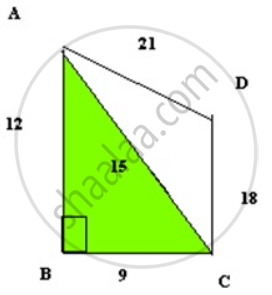
In the given quadrilateral ABCD, join diagonal AC
ABC is a right triangle
We know that, Area of a Triangle = `(1)/(2)"b.h" "i.e" (1)/(2)("Base" xx "Height")`
Area of a Triangle ABC = `(1)/(2)9.12` = 54m2
AC is the hypotenuse, AC
= `sqrt(12^2 + 9^2)`
= `sqrt(225)`
= 15m
Triangle ACD has sides 15m, 18m, 21m
We know that, Area of a Triangle whose sides are a, b, and c and semiperimeter is s is given by `sqrt("s"("s" - "a")("s" - "b")("s" -"c")); "s" = ("a" + "b" + "c")/(2)`
For a triangle whose sides are cm, cm and cm
i.e a = 15, b = 18 and c = 21,
s = `(15 + 18 + 21)/(2)`
= `(54)/(2)`
= 27
Area
= `sqrt(27(27 - 15)(27 - 18)(27 - 21)`
= `sqrt(27(12)(9)(6)`
= `sqrt(9 xx 3(6 xx 2)(9)(6)`
= `9 xx 6sqrt(6)`
= `54sqrt(6)`
= 54(2.5)
Area(Quad ABCD) = Ar(Triangle ABC) + Ar(Triangle ADC)
54 + 54(2.5)
= 54(1 + 2.5)
= 54(3.5)
= 189m2.
APPEARS IN
संबंधित प्रश्न
The length of a rectangle is twice the side of a square and its width is 6 cm greater than the side of the square. If the area of the rectangle is three times the area of the square; find the dimensions of each.
Trapezium given below; find its area.
The length and the breadth of a rectangle are 6 cm and 4 cm respectively. Find the height of a triangle whose base is 6 cm and the area is 3 times that of the rectangle.
The figure given below shows the cross-section of a concrete structure. Calculate the area of cross-section if AB = 1.8 cm, CD = 0.6 m, DE = 0.8 m, EF = 0.3 m and AF = 1.2 m.

The floor of a room is of size 6 m x 5 m. Find the cost of covering the floor of the room with 50 cm wide carpet at the rate of Rs.24.50 per metre. Also, find the cost of carpeting the same hall if the carpet, 60 cm, wide, is at the rate of Rs.26 per metre.
Find the diagonal of a quadrilateral whose area is 756cm2 and the perpendicular from the opposite vertices are 17cm and 19cm.
Find the area of the quadrilateral whose vertices are at (– 9, 0), (– 8, 6), (– 1, – 2) and (– 6, – 3)
Find the area of quadrilateral BCEG
If the diagonal d of a quadrilateral is doubled and the heights h1 and h2 falling on d are halved, then the area of quadrilateral is ______.
