Advertisements
Advertisements
Question
Find the area of a quadrilateral field whose sides are 12m, 9m, 18m and 21m respectively and the angle between the first two sides is a right angle. Take the value of `sqrt(6)` as 2.5.
Advertisements
Solution
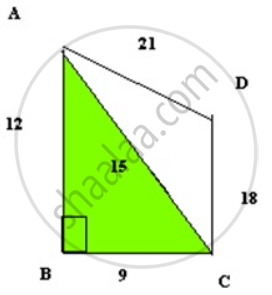
In the given quadrilateral ABCD, join diagonal AC
ABC is a right triangle
We know that, Area of a Triangle = `(1)/(2)"b.h" "i.e" (1)/(2)("Base" xx "Height")`
Area of a Triangle ABC = `(1)/(2)9.12` = 54m2
AC is the hypotenuse, AC
= `sqrt(12^2 + 9^2)`
= `sqrt(225)`
= 15m
Triangle ACD has sides 15m, 18m, 21m
We know that, Area of a Triangle whose sides are a, b, and c and semiperimeter is s is given by `sqrt("s"("s" - "a")("s" - "b")("s" -"c")); "s" = ("a" + "b" + "c")/(2)`
For a triangle whose sides are cm, cm and cm
i.e a = 15, b = 18 and c = 21,
s = `(15 + 18 + 21)/(2)`
= `(54)/(2)`
= 27
Area
= `sqrt(27(27 - 15)(27 - 18)(27 - 21)`
= `sqrt(27(12)(9)(6)`
= `sqrt(9 xx 3(6 xx 2)(9)(6)`
= `9 xx 6sqrt(6)`
= `54sqrt(6)`
= 54(2.5)
Area(Quad ABCD) = Ar(Triangle ABC) + Ar(Triangle ADC)
54 + 54(2.5)
= 54(1 + 2.5)
= 54(3.5)
= 189m2.
APPEARS IN
RELATED QUESTIONS
The diagonal of a quadrilateral shaped field is 24 m and the perpendiculars dropped on it from the remaining opposite vertices are 8 m and 13 m. Find the area of the field.

A wire when bent in the form of a square encloses an area = 576 cm2. Find the largest area enclosed by the same wire when bent to form;
(i) an equilateral triangle.
(ii) A rectangle whose adjacent sides differ by 4 cm.
A rectangular plot 85 m long and 60 m broad is to be covered with grass leaving 5 m all around. Find the area to be laid with grass.
A footpath of uniform width runs all around the outside of a rectangular field 30 m long and 24 m wide. If the path occupies an area of 360 m2, find its width.
The perimeter of a rhombus is 52 cm. If one diagonal is 24 cm; find:
(i) The length of its other diagonal,
(ii) Its area.
The area of a rhombus is 216 sq. cm. If it's one diagonal is 24 cm; find:
(i) Length of its other diagonal,
(ii) Length of its side,
(iii) The perimeter of the rhombus.
Vertices of given triangles are taken in order and their areas are provided aside. Find the value of ‘p’.
| Vertices | Area (sq.units) |
| (0, 0), (p, 8), (6, 2) | 20 |
In the following, find the value of ‘a’ for which the given points are collinear
(2, 3), (4, a) and (6, – 3)
Find the area of the quadrilateral whose vertices are at (– 9, – 2), (– 8, – 4), (2, 2) and (1, – 3)
When proving that a quadrilateral is a trapezium, it is necessary to show
