हिंदी

Trapezium Given Below; Find Its Area. - Mathematics

Advertisements
Advertisements

प्रश्न

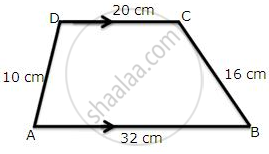
 Trapezium given below; find its area.
योग
Advertisements

उत्तर
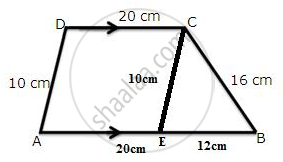

For the triangle EBC,
S = 19 cm

Area of ΔEBC = `sqrt( 19 xx ( 19 - 16 ) xx ( 19 - 12 ) xx ( 19 - 10 ))`

= `sqrt( 19 xx 3 xx 7 xx 9 )`

= 59.9 sq.cm

Let h be the height.
Area of ΔEBC= `1/2` x 12 x h
⇒ 59.9 = 6h
⇒ h = `59.9/6` = 9.98 cm

Area of ABCD = `1/2` x ( 20 + 32 ) x 9.98

                       = `1/2` x 52 x 9.98
                       = 259.48 cm2

shaalaa.com
  क्या इस प्रश्न या उत्तर में कोई त्रुटि है?
अध्याय 20: Area and Perimeter of Plane Figures - Exercise 20 (B) [पृष्ठ २५६]

APPEARS IN

सेलिना Concise Mathematics [English] Class 9 ICSE
अध्याय 20 Area and Perimeter of Plane Figures
Exercise 20 (B) | Q 27.3 | पृष्ठ २५६

संबंधित प्रश्न

The distance between parallel sides of a trapezium is 15 cm and the length of the line segment joining the mid-points of its non-parallel sides is 26 cm. Find the area of the trapezium.


A wire when bent in the form of a square encloses an area = 576 cm2. Find the largest area enclosed by the same wire when bent to form;
(i) an equilateral triangle.
(ii) A rectangle whose adjacent sides differ by 4 cm.


The diagram, given below, shows two paths drawn inside a rectangular field 80 m long and 45 m wide. The widths of the two paths are 8 m and 15 m as shown. Find the area of the shaded portion. 


The shaded region of the given diagram represents the lawn in the form of a house. On the three sides of the lawn, there are flowerbeds having a uniform width of 2 m.

(i) Find the length and the breadth of the lawn.
(ii) Hence, or otherwise, find the area of the flower-beds.


Find the area and the perimeter of a square with diagonal 24 cm. [Take √2 = 1.41 ] 


Find the area of the quadrilateral whose vertices are at (– 9, 0), (– 8, 6), (– 1, – 2) and (– 6, – 3)


Find the area of quadrilateral BCEG


When proving that a quadrilateral is a trapezium, it is necessary to show


PQRS is a rectangle formed by joining the points P(– 1, – 1), Q(– 1, 4), R(5, 4) and S(5, – 1). A, B, C and D are the mid-points of PQ, QR, RS and SP respectively. Is the quadrilateral ABCD a square, a rectangle or a rhombus? Justify your answer.


If the diagonal d of a quadrilateral is doubled and the heights h1 and h2 falling on d are halved, then the area of quadrilateral is ______.


Share
Notifications

Englishहिंदीमराठी


      Forgot password?
Use app×