Advertisements
Advertisements
प्रश्न
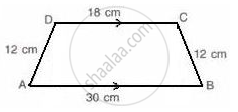
Trapezium given below; find its area.
Advertisements
उत्तर
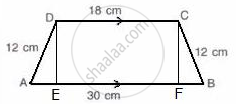
In the given figure, we can observe that the non-parallel sides are equal and hence it is an isosceles trapezium.
Therefore, let us draw DE and CF perpendiculars to AB.
Thus, the area of the parallelogram is given by
AB = AE + EF + FB and CD = EF = 18 cm, we have
30 = AE + 18 + FB
⇒ 30 = AE + 18 + AE
⇒ 2AE + 18 = 30
⇒ 2AE = 30 - 18
⇒ 2AE = 12
⇒ AE = 6 cm
Now, consider the right angled triangle ADE.
AD2 = AE2 + DE2
⇒ 122 = 62 + DE2
⇒ 144 = 36 + DE2
⇒ DE2 = 144 - 36
⇒ DE2 = 108
⇒ DE = `sqrt( 36 xx 3 )`
⇒ DE = `6sqrt3`
Area( `square"ABCD" ) = "Area"( Δ"ADE" ) + "Area"( square "DEFC") + "Area"( Δ"CFB" )`
⇒ Area( `square"ABCD" ) = 1/2 xx 6 xx 6sqrt3 + 18 xx 6sqrt3 + 1/2 xx 6 xx 6sqrt3`
⇒ Area( `square"ABCD" ) = 6 xx 6sqrt3 + 18 xx 6sqrt3`
⇒ Area( `square"ABCD") = 144sqrt3`= 249.41 cm2
APPEARS IN
संबंधित प्रश्न
The diagonal of a rectangular plot is 34 m and its perimeter is 92 m. Find its area.
Find the area of a quadrilateral one of whose diagonals is 30 cm long and the perpendiculars from the other two vertices are 19 cm and 11 cm respectively.
The diagonals of a quadrilateral are 16 cm and 13 cm. If they intersect each other at right angles; find the area of the quadrilateral.
ABCD is a square with each side 12 cm. P is a point on BC such that area of ΔABP: area of trapezium APCD = 1: 5. Find the length of CP.
The cost of enclosing a rectangular garden with a fence all around, at the rate of 75 paise per metre, is Rs. 300. If the length of the garden is 120 metres, find the area of the field in square metres.
The perimeter of a semicircular plate is 108 cm. find its area.
Find the diagonal of a quadrilateral whose area is 756cm2 and the perpendicular from the opposite vertices are 17cm and 19cm.
In the following, find the value of ‘a’ for which the given points are collinear
(a, 2 – 2a), (– a + 1, 2a) and (– 4 – a, 6 – 2a)
Let P(11, 7), Q(13.5, 4) and R(9.5, 4) be the midpoints of the sides AB, BC and AC respectively of ∆ABC. Find the coordinates of the vertices A, B and C. Hence find the area of ∆ABC and compare this with area of ∆PQR.
If the diagonal d of a quadrilateral is doubled and the heights h1 and h2 falling on d are halved, then the area of quadrilateral is ______.
