Advertisements
Advertisements
प्रश्न
Find the area of quadrilateral BCEG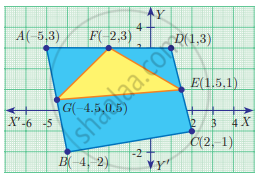
Advertisements
उत्तर
Area of the Quadrilateral BCEG = `1/2 [(x_1y_2 + x_2y_3 + x_3y_4 + x_4y_1) - (x_2y_1 + x_3y_2 + x_4y_3 + x_1y_4)]`

= `1/2[(4 + 2 + 0.75 + 9) - (-4 - 1.5 - 4.5 - 2)]`
= `1/2[15.75 + 12]`
= `1/2 [27.75]`
= 13.875
= 13.88 sq. units
APPEARS IN
संबंधित प्रश्न
Diagram of the adjacent picture frame has outer dimensions = 24 cm × 28 cm and inner dimensions 16 cm × 20 cm. Find the area of each section of the frame, if the width of each section is same.
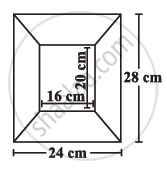
The diagonal of a quadrilateral shaped field is 24 m and the perpendiculars dropped on it from the remaining opposite vertices are 8 m and 13 m. Find the area of the field.
Calculate the area of quadrilateral ABCD, in which ∠ABD = 90°, triangle BCD is an equilateral triangle of side 24 cm and AD = 26 cm.
Trapezium given below; find its area.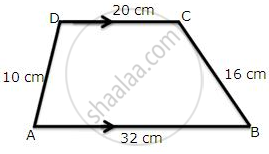
Trapezium given below; find its area.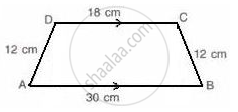
The length and the breadth of a rectangle are 6 cm and 4 cm respectively. Find the height of a triangle whose base is 6 cm and the area is 3 times that of the rectangle.
The perimeter of a rhombus is 46 cm. If the height of the rhombus is 8 cm; find its area.
Find the area and the perimeter of a square with diagonal 24 cm. [Take √2 = 1.41 ]
In the following, find the value of ‘a’ for which the given points are collinear
(a, 2 – 2a), (– a + 1, 2a) and (– 4 – a, 6 – 2a)
Find the area of the quadrilateral whose vertices are at (– 9, – 2), (– 8, – 4), (2, 2) and (1, – 3)
