Advertisements
Advertisements
प्रश्न
Let P(11, 7), Q(13.5, 4) and R(9.5, 4) be the midpoints of the sides AB, BC and AC respectively of ∆ABC. Find the coordinates of the vertices A, B and C. Hence find the area of ∆ABC and compare this with area of ∆PQR.
Advertisements
उत्तर
Let the vertices of the ∆ABC be A(x1, y1), B(x2, y2), C(x3, y3)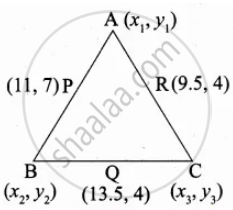
Mid point of AB = `((x_1 + x_2)/2, (y_1 + y_2)/2)`
(11, 7) = `((x_1 + x_2)/2, (y_1 + y_2)/2)`
|
`(x_1 + x_2)/2` = 11 x1 + x2 = 22 ...(1) |
`(y_1 + y_2)/2` = 7 y1 + y2 = 14 ...(2) |
Mid point of BC = `((x_2 + x_3)/2, (y_2 + y_3)/2)`
⇒ (13.5, 4) = `((x_2 + x_3)/2, (y_2 + y_3)/2)`
|
`(x_2 + x_3)/2` = 13.5 x2 + x3 = 27 ...(3) |
`(y_2 + y_3)/2` = 4 y2 + y3 = 8 ...(4) |
Mid point of AC = `((x_1 + x_3)/2, (y_1 + y_3)/2)`
(9.5, 4) = `((x_1 + x_2)/2, (y_1 + y_3)/2)`
|
`(x_1 + x_3)/2` = 9.5 x1 + x3 = 19 ...(5) |
`(y_1 + y_3)/2` = 4 y1 + y3 = 8 ...(6) |
Add (1), (3) and (5)
2x1 + 2x2 + 2x3 = 22 + 27 + 19
2(x1 + x2 + x3) = 68
x1 + x2 + x3 = 34
From (1) ⇒ x1 + x2 = 22
x3 = 34 – 22 = 12
From (3) ⇒ x2 + x3 = 27
x1 = 34 – 27 = 7
From (5) ⇒ x1 + x3 = 19
x2 = 34 – 19 = 15
Add (2), (4) and (6)
2y1 + 2y2 + 2y3 = 14 + 8 + 8
2(y1 + y2 + y3) = 30
y1 + y2 + y3 = 15
From (2) ⇒ y1 + y2 = 14
y3 = 15 – 14 = 1
From (4) ⇒ y2 + y3 = 18
y1 = 15 – 8 = 7
From (6) ⇒ y1 + y3 = 8
y2 = 15 – 8 = 7
The vertices of a ΔABC are A(7, 7), B(15, 7) and C(12, 1)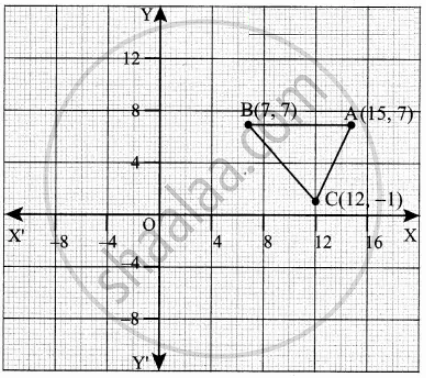
Area of ΔABC = `1/2[(x_1y_2 + x_2y_3 + x_3y_1) - (x_2y_1 + x_3y_2 + x_1y_3)]`
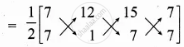
= `1/2[(7 + 84 + 105) - (84 + 15 + 49)]`
= `1/2[196 - 148]`
= `1/2 xx 48`
= 24 sq. units
Area of ΔPRQ = `1/2[(44 + 8 + 94.5) - (66.5 + 54 + 44)]`
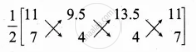
= `1/2[176.5 - 164.5]`
= `1/2 xx 12`
= 6 sq. units
APPEARS IN
संबंधित प्रश्न
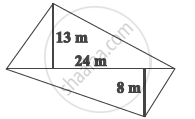
The diagonal of a quadrilateral shaped field is 24 m and the perpendiculars dropped on it from the remaining opposite vertices are 8 m and 13 m. Find the area of the field.
The diagonals of a quadrilateral are 16 cm and 13 cm. If they intersect each other at right angles; find the area of the quadrilateral.
Trapezium given below; find its area.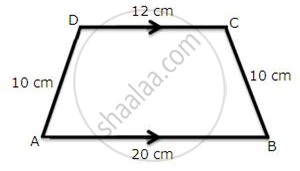
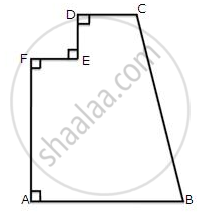
The figure given below shows the cross-section of a concrete structure. Calculate the area of cross-section if AB = 1.8 cm, CD = 0.6 m, DE = 0.8 m, EF = 0.3 m and AF = 1.2 m.
The perimeter of a rhombus is 46 cm. If the height of the rhombus is 8 cm; find its area.
The length of a rectangular verandah is 3 m more than its breadth. The numerical value of its area is equal to the numerical value of its perimeter.
(i) Taking x as the breadth of the verandah, write an equation in x that represents the above statement
(ii) Solve the equation obtained in (i) above and hence find the dimensions of the verandah.
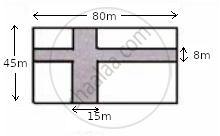
The diagram, given below, shows two paths drawn inside a rectangular field 80 m long and 45 m wide. The widths of the two paths are 8 m and 15 m as shown. Find the area of the shaded portion.
Find the area and the perimeter of a square with diagonal 24 cm. [Take √2 = 1.41 ]
Find the diagonal of a quadrilateral whose area is 756cm2 and the perpendicular from the opposite vertices are 17cm and 19cm.
Find the area of the quadrilateral whose vertices are at (– 9, 0), (– 8, 6), (– 1, – 2) and (– 6, – 3)
