Advertisements
Advertisements
प्रश्न
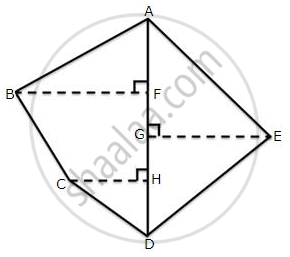
The following diagram shows a pentagonal field ABCDE in which the lengths of AF, FG, GH, and HD are 50 m, 40 m, 15 m and 25 m, respectively, and the lengths of perpendiculars BF, CH and EG are 50 m, 25 m and 60 m respectively. Determine the area of the field.
Advertisements
उत्तर
We can divide the field into three triangles and one trapezium.
Let A, B, C be the three triangular regions and D be the trapezoidal region.
Now,
Area of A = `1/2` x AD x GE
= `1/2` x ( 50 + 40 + 15 + 25 ) x 60
= 3900 sq.m
Area of B = `1/2` x AF x BF
= `1/2` x 50 x 50
= 1250 sq.m
Area of C = `1/2` x HD x CH
= `1/2` x 25 x 25
= 312.5 sq.m.
Area of D = `1/2` x ( BF + CH ) x ( FG + GH )
= `1/2` x ( 50 + 25 ) x ( 40 + 15 )
= `1/2` x 75 x 55
= 2062.5 sq.cm
Area of the figure = Area of A + Area of B + Area of C + Area of D
= 3900 + 1250 + 312.5 + 2062.5
= 7525 sq.m
APPEARS IN
संबंधित प्रश्न
The diagonal of a quadrilateral shaped field is 24 m and the perpendiculars dropped on it from the remaining opposite vertices are 8 m and 13 m. Find the area of the field.
Calculate the area of quadrilateral ABCD, in which ∠ABD = 90°, triangle BCD is an equilateral triangle of side 24 cm and AD = 26 cm.
Trapezium given below; find its area.
Calculate the area of the figure given below:
Which is not drawn scale.

The length of a rectangular verandah is 3 m more than its breadth. The numerical value of its area is equal to the numerical value of its perimeter.
(i) Taking x as the breadth of the verandah, write an equation in x that represents the above statement
(ii) Solve the equation obtained in (i) above and hence find the dimensions of the verandah.
Two adjacent sides of a parallelogram are 28 cm and 26 cm. If one diagonal of it is 30 cm long; find the area of the parallelogram. Also, find the distance between its shorter sides.
Find the value of k, if the area of a quadrilateral is 28 sq. units, whose vertices are (– 4, – 2), (– 3, k), (3, – 2) and (2, 3)
Let P(11, 7), Q(13.5, 4) and R(9.5, 4) be the midpoints of the sides AB, BC and AC respectively of ∆ABC. Find the coordinates of the vertices A, B and C. Hence find the area of ∆ABC and compare this with area of ∆PQR.
The quadrilateral swimming pool shown is surrounded by concrete patio. Find the area of the patio
Find the area of quadrilateral BCEG
