Advertisements
Advertisements
प्रश्न
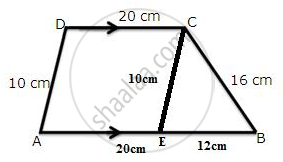
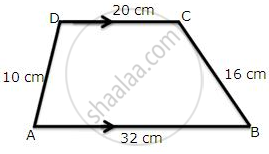
Trapezium given below; find its area.
Advertisements
उत्तर

For the triangle EBC,
S = 19 cm
Area of ΔEBC = `sqrt( 19 xx ( 19 - 16 ) xx ( 19 - 12 ) xx ( 19 - 10 ))`
= `sqrt( 19 xx 3 xx 7 xx 9 )`
= 59.9 sq.cm
Let h be the height.
Area of ΔEBC= `1/2` x 12 x h
⇒ 59.9 = 6h
⇒ h = `59.9/6` = 9.98 cm
Area of ABCD = `1/2` x ( 20 + 32 ) x 9.98
= `1/2` x 52 x 9.98
= 259.48 cm2
APPEARS IN
संबंधित प्रश्न
A wire when bent in the form of a square encloses an area = 576 cm2. Find the largest area enclosed by the same wire when bent to form;
(i) an equilateral triangle.
(ii) A rectangle whose adjacent sides differ by 4 cm.
Trapezium given below; find its area.

Calculate the area of quadrilateral ABCD in which AB = 32 cm, AD = 24 cm ∠A = 90° and BC = CD = 52 cm.
The perimeter of a rhombus is 46 cm. If the height of the rhombus is 8 cm; find its area.
The perimeter of a rhombus is 52 cm. If one diagonal is 24 cm; find:
(i) The length of its other diagonal,
(ii) Its area.
A quadrilateral field of unequal has a longer diagonal with 140m. The perpendiculars from opposite vertives upon this diagonal are 20m and 14m. Find the area of the field.
Find the area of quadrilateral PQRS.

The quadrilateral swimming pool shown is surrounded by concrete patio. Find the area of the patio
When proving that a quadrilateral is a trapezium, it is necessary to show
When proving that a quadrilateral is a parallelogram by using slopes you must find