Advertisements
Advertisements
Question
Find the value of k, if the area of a quadrilateral is 28 sq. units, whose vertices are (– 4, – 2), (– 3, k), (3, – 2) and (2, 3)
Advertisements
Solution
Let the vertices A(– 4, – 2), B(– 3, k), C(3, – 2) and D(2, 3)
Area of the Quadrilateral = 28 sq. units
`1/2[(x_1y_2 + x_2y_3 + x_3y_4 + x_4y_1) - (x_2y_1 + x_3y_2 + x_4y_3 + x_1y_4)]` = 28

`1/2[(-4"k" + 6 + 9 - 4) - (6 + 3"k" - 4 - 12)]` = 28
`1/2[(-4"k" + 11) - (3"k" - 10)]` = 28
– 4k + 11 – 3k + 10 = 56
– 7k + 21 = 56
– 7k = 56 – 21
– 7k = 35
⇒ 7k = – 35
k = `35/7`
= – 5
The value of k = – 5
APPEARS IN
RELATED QUESTIONS
The area of a parallelogram is y cm2 and its height is h cm. The base of another parallelogram is x cm more than the base of the first parallelogram and its area is twice the area of the first. Find, in terms of y, h, and x, the expression for the height of the second parallelogram.
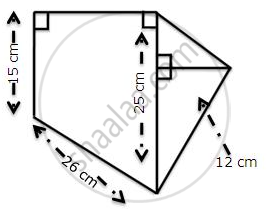
Calculate the area of the figure given below:
Which is not drawn scale.
The cost of enclosing a rectangular garden with a fence all around, at the rate of 75 paise per metre, is Rs. 300. If the length of the garden is 120 metres, find the area of the field in square metres.
The width of a rectangular room is `4/7`of its length, x, and its perimeter is y. Write an equation connecting x and y. Find the length of the room when the perimeter is 4400 cm.
Two adjacent sides of a parallelogram are 28 cm and 26 cm. If one diagonal of it is 30 cm long; find the area of the parallelogram. Also, find the distance between its shorter sides.
Find the area and perimeter of a square plot of land, the length of whose diagonal is 15 meters. Given your answer correct to 2 places of decimals.
Find the area of the quadrilateral whose vertices are at (– 9, – 2), (– 8, – 4), (2, 2) and (1, – 3)
Find the area of the quadrilateral whose vertices are at (– 9, 0), (– 8, 6), (– 1, – 2) and (– 6, – 3)
Let P(11, 7), Q(13.5, 4) and R(9.5, 4) be the midpoints of the sides AB, BC and AC respectively of ∆ABC. Find the coordinates of the vertices A, B and C. Hence find the area of ∆ABC and compare this with area of ∆PQR.
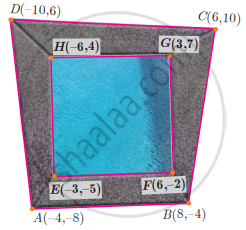
The quadrilateral swimming pool shown is surrounded by concrete patio. Find the area of the patio