Advertisements
Advertisements
Question
Using the information in the following figure, find its area.
Advertisements
Solution
Construction : Draw CM ⊥ AB
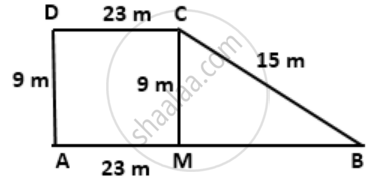
In right-angled triangle CMB,
BM2 = BC2 - CM2 = (15)2 - (9)2 = 225 - 81 = 144
⇒ BM = 12 m
Now, AB = AM + BM = 23 + 12 = 35 m
∴ Area of trapezium ABCD
=`1/2` x ( sum of parallel sides ) x Heigt
=`1/2` x (AB + CD) x AD
= `1/2` x ( 23 + 35 ) x 9
= `1/2` x 58 x 9
= 261 m2
APPEARS IN
RELATED QUESTIONS
The diagonal of a quadrilateral shaped field is 24 m and the perpendiculars dropped on it from the remaining opposite vertices are 8 m and 13 m. Find the area of the field.
The area of a rectangular is 640 m2. Taking its length as x cm; find in terms of x, the width of the rectangle. If the perimeter of the rectangle is 104 m; find its dimensions.
A footpath of uniform width runs all around the outside of a rectangular field 30 m long and 24 m wide. If the path occupies an area of 360 m2, find its width.
The length of a rectangular verandah is 3 m more than its breadth. The numerical value of its area is equal to the numerical value of its perimeter.
(i) Taking x as the breadth of the verandah, write an equation in x that represents the above statement
(ii) Solve the equation obtained in (i) above and hence find the dimensions of the verandah.
The area of a rhombus is 216 sq. cm. If it's one diagonal is 24 cm; find:
(i) Length of its other diagonal,
(ii) Length of its side,
(iii) The perimeter of the rhombus.
The diagram, given below, shows two paths drawn inside a rectangular field 80 m long and 45 m wide. The widths of the two paths are 8 m and 15 m as shown. Find the area of the shaded portion.

Find the area and the perimeter of a square with diagonal 24 cm. [Take √2 = 1.41 ]
Let P(11, 7), Q(13.5, 4) and R(9.5, 4) be the midpoints of the sides AB, BC and AC respectively of ∆ABC. Find the coordinates of the vertices A, B and C. Hence find the area of ∆ABC and compare this with area of ∆PQR.
The quadrilateral swimming pool shown is surrounded by concrete patio. Find the area of the patio
PQRS is a rectangle formed by joining the points P(– 1, – 1), Q(– 1, 4), R(5, 4) and S(5, – 1). A, B, C and D are the mid-points of PQ, QR, RS and SP respectively. Is the quadrilateral ABCD a square, a rectangle or a rhombus? Justify your answer.
