Advertisements
Advertisements
Question
‘It was worth a wound—it was worth many wounds—to know the depth of loyalty and love that lay behind that cold mask’— how does this comment throw light on the kind of relationship between Holmes and Watson?
Advertisements
Solution
The expression is made by Watson on being shot on his thigh by Killer Evans. When he got shot, Holmes led him to a chair and with great concern asked him if was hurt. For the first time, Says Watson, the clear hard eyes of Holmes were dimmed for a moment and firm lips were shaking. Watson says that it was worth a wound, worth many wounds, to know the depth of loyalty and love that lay behind that cold mask. It was no doubt a professional relation that Holmes and Watson shared. However, it had grown into a friendship that ran much deeper than it appeared. It was at this moment that Watson caught a glimpse of a great heart as well as of a great brain.
APPEARS IN
RELATED QUESTIONS
Arun was asked by his mother to explain the missing buttons on his shirt.
(Rewrite: Using ‘explanation’)
You had gone on a trekking expendition with a group of friends. As night closed in, you realised that you were separated from the group. Describe your initial feelings and the place where you got lost. How did you spend the night alone before you were reunited with your group?
Fill in the blanks in the passage givben below with the appropriate form of the verb given in brackets. Do not write the passage, but write the verbs in the correct order.
One day I ____________ (1)(be) in the lunch line, and there I saw a pile of apples. The teacher-incharge _____________ (2)(state) at me and said, “Just __________ (3)(take) one. God ________ (4)(watch)”. So, I ____________ (5)(take) an apple, and the line __________ (6)(move) along. At the next table there ____________ (7)(be) a pile of chocolate chip cookies. I ____________ (8)(not know) what to do. “Put,” the kid behind me ____________ (9)(whisper), “_____________ (10)(take) all you want. God’s watching the apples. ”
Can we say that the poet has succeeded in conveying his point? How?
Define the following terms from the poem: rivulet, plough share (plowshare), yon, and childing.
Do you think Dahl is being extreme when he recommends that television sets should be tossed-out of our homes? Is there a balance which could be struck between watching television and reading books? What would that balance be?
How did the last event turn out to be special?
The eight other runners pulled up on their heels
The ones who had trained for so long to complete
one by one they all turned around and went back to help him
And brought the young boy to his feet.
Then all the nine runners joined hands and continued
The hundred-yard dash now reduced to a walk
And a banner above that said (Special Olympics)
Could not have been more on the mark.
That's how the race ended, with nine gold medals
They came to the finish line holding hands still
And a standing ovation and nine beaming faces
Said more than these words ever will.
Read the lines given above and answer the following question:
Explain the following phrases in a sentence or two.
(a) Pulled up on their heels
(b) Brought the young boy to his feet.
What are the techniques used by Ruskin Bond to create an atmosphere of strangeness, mystery and super naturalism in the story? Can Ruskin Bond be called a visual writer? Why?
(A) Ashita is the most beautiful girt in the class.
(B) No ………………………………..
I was laid________for three weeks with a broken leg.
A number of loose electric wires are hanging from a lamp post near the main gate of your school. Write a letter to the Municipal Commissioner explaining the problem, the danger it poses and suggests a quick solution.
Since her childhood, Meera has been good in Mathematics.
(End: ............................ childhood)
It is dangerous as well as illegal to drive a motorcycle without a helmet. (Begin: It is not ................................................. )
The following common words are used in more than one sense.
-
panel
studio
brush
essence
material
Examine the following sets of sentences to find out what the words, ‘panel’ and ‘essence’ mean in different contexts.
1. (i) The masks from Bawa village in Mali look like long panels of decorated wood.
(ii) Judge H. Hobart Grooms told the jury panel he had heard the reports.
(iii)The panel is laying the groundwork for an international treaty.
(iv)The glass panels of the window were broken.
(v) Through the many round tables, workshops and panel discussions, a consensus was reached.
(vi)The sink in the hinged panel above the bunk drains into the head.
2. (i) Their repetitive structure must have taught the people around the great composer the essence of music.
(ii) Part of the answer is in the proposition; but the essence is in the meaning.
(iii)The implications of these schools of thought are of practical essence for the teacher.
(iv) They had added vanilla essence to the pudding.
Combine the following sets of ideas to show the contrast between them.
(i)The Emperor commissions a painting and appreciates its outer appearance.
(ii)The artist reveals to him the true meaning of his work.
Combine the following sets of ideas to show the contrast between them.
(i) The Emperor may rule over the territory he has conquered.
(ii) The artist knows the way within.
Find out about experiments in recycling that help in environmental conservation.
Given below is the dictionary meaning of
Smirk: to smile in a silly or unpleasant way that shows that you are pleased with yourself.
Look up the dictionary for the following words which are also related to facial expressions and write down the meaning of each
|
smile |
grin |
grimace |
sneer |
How does the narrator bring out the contrast between the Indian way of life and American society? Do you think his wife Mala adjusted comfortably to the new way of life?
Your teacher will speak the word given below. Write against two new words that rhyme with it.
bed ______ ______
Multiple Choice Question:
Why did the quarrel take a serious turn?
We add ‘un-’ to make opposites. For example, true — untrue. Add ‘un’– to the word below to make its opposite. Then look up the meaning of the word you have formed in the dictionary.
qualified: ____________
Given below are some words that are spelt differently in British and American English. Fill in the blanks accordingly.
| British | American |
| 1. colour | ______ |
| 2. ______ | labor |
| 3. ______ | traveler |
| 4. counsellor | ______ |
| 5. centre | ______ |
| 6. ______ | theater |
| 7. ______ | organize |
| 8. realise | ______ |
| 9. ______ | defense |
| 10. offence | ______ |
Complete the following web diagram.

Complete the following web diagram.

Match the following.
| Sr. No | A | B |
|
| 1. | Constitution | a. | It is the freedom to go where you want, do what you want, etc. |
| 2. | Liberty | b. | It is the state of being equal, especially in status, rights, or opportunities. |
| 3. | Equality | c. | It is a sense of common brotherhood. |
| 4. | Fraternity | d. | It is an aggregate of fundamental principles or established precedents that constitute the legal basis of a polity, organization, or other types of entity and commonly determine how that entity is to be governed. |
Imagine that you are the fellow pilgrim and you wish to share your experience of the incident in the poem.
Write a short article about it for a magazine/journal. Also, convey what change it has brought in your life.
Write your views/opinions in brief on the following topic.
Liberty, equality, and fraternity lead to an ideal nation.
Discuss with your partner and make a list of steps that you feel are essential to unite the people of different castes, races, religions, and languages in India.
Different arms and ammunitions are mentioned in the excerpt. Find their names.
Visit the library and collect at least five poems of any Nature poet. Write the poems along with their summary.
Write a summary of the poem with the help of the points given below:
- Title
- Introductory paragraph (about the poem/type/nature/tone)
- Main body (central idea/gist of the poem)
- Conclusion/opinions/views/appeal.
Imagine that you are a compere of a ‘Prize Distribution Ceremony’ of your college. Write a script for the same.
You can take the help of the following points.
- Introduction – A brief introduction of the programme / function / show
- Welcome speech – Welcome to all guests. Felicitation – felicitation of the guests (the principal, vice-principal, etc.).
- Lighting the lamp
- Welcome song
- Main events
- Vote of thanks
Write down the consequences of the following occurrences with the help of the play.
Dr. Thomas Stockmann wants an article exposing social evils to be printed in the newspaper.
Is there something that you would like to own more than anything else? Describe your dream possession with the help of the following points. You may add your own points, too.
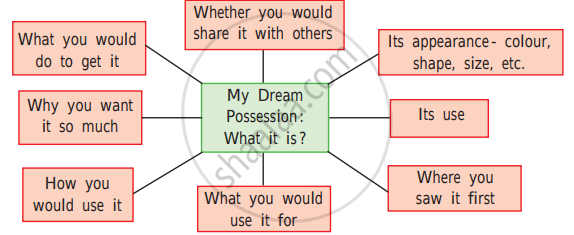
Discuss the following and write about the following in your own words in 5-6 lines.
What would you do, if something like this happens to you?
The same landscape appears different at different times. What message can we draw from this?
Why should seniors not overprotect or over - pamper juniors?
Imagine you are Dorothy and write about the day’s events in 5-8 lines in your (Dorothy’s) diary.
Imagine you are the lion and someone is interviewing you.
Write the answer to the following question.
Who were your companions on the way to Oz?
Prepare a set of questions to interview:
a person who has just returned from a trek in the woods.
Write a news report on the ‘Environment Day’ celebrated in your school.
Imagine yourself as the writer. Narrate the story of your visit to your ancestral house.
Work in pairs. Create three slogans on ‘Saving Trees’.
Read this example Save a Tree Get Oxygen for Free.
- Use catchy, meaningful phrases.
- Do not write complete sentences.
- Ensure that the words at the end rhyme.
You have won the first prize in the essay writing competition. ______
Answer the question by looking at the picture.
Example: What is happening in picture 5?
What are Anil and his friends pulling in picture 3?

______are pulling______
Can you write six things that are made of wood?
Look at the words given below and put them under the things that they are made of –

The grandmother was strong-minded. Justify
How is that day celebrated?
What did he keep doing while on his rounds?
What was Sletherby’s response to Bertie’s request?
How would Miss Meadows usually treat Mary? How did her behavior towards the girl change that day?
Why had Miss Meadows chosen 'A Lament' as the lesson that particular day?
Write a composition in approximately 350 – 400 words on the following subject:
(You are reminded that you will be rewarded for orderly and coherent presentation of material, use of appropriate style and general accuracy of spelling, punctuation, and grammar.)
Lockdown.
Answer the following question as briefly as possible and with close reference to the relevant text.
Discuss how in the poem Dover Beach the poet, Mathew Arnold, reposes faith in love as a beam of hope amidst the surrounding despair.
"A Daniel come to judgement! Yea a Daniel" Who is being described in these words? By whom?
Complete the dialogue.
| Anil: | Which is your favourite book? |
| Sunil: | ______________________ |
| Anil: | What type of book is it? |
| Sunil: | _____________________ |
How do Prospero, Ferdinand and Caliban perceive Miranda? Give one example of each of their perceptions, from the Acts studied, to support your answer. Write your answer in a short paragraph of about 100-150 words.
