Advertisements
Advertisements
Question
In which direction does conventional current flow around a circuit?
Advertisements
Solution
The direction of conventional current is from the positive terminal of a cell or battery to the negative terminal through the outer circuit.
APPEARS IN
RELATED QUESTIONS
A car headlight bulb working on a 12 V car battery draws a current of 0.5 A. The resistance of the light bulb is:
(a) 0.5 Ω
(b) 6 Ω
(c) 12 Ω
(d) 24 Ω
An electric bulb of resistance 20 Ω and a resistance wire of 4 Ω are connected in series with a 6 V battery.
Draw the circuit diagram, and calculate:
(a) total resistance of the circuit.
(b) current through the circuit.
(c) potential difference across the electric bulb.
(d) potential difference across the resistance wire.
In the circuit diagram given below five resistances of 10 Ω, 40 Ω, 30 Ω, 20 Ω, and 60 Ω are connected as shown to a 12 V battery.
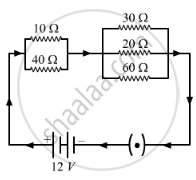
Calculate:
(a) total resistance in the circuit.
(b) total current flowing in the circuit.
You can given one hundred 1 Ω resistors. What is the smallest and largest resistance you can make in a circuit using these?
Which is the better way to connect lights and other electrical appliances in domestic wiring: series circuits or parallel circuits? why?
For a heater rated at 4 kW and 220 V, calculate:
(a) the current,
(b) the resistance of the heater,
(c) the energy consumed in 2 hours, and
(d) the cost if 1 kWh is priced at Rs 4.60.
Name two effects produced by electric current.
Two resistors of 2.0 Ω and 3.0 Ω are connected (a) in series (b) in parallel, with a battery of 6.0 V and negligible internal resistance. For each case draw a circuit diagram and calculate the current through the battery.
A cell supplies a current of 1.2 A through two 2 Ω resistors connected in parallel. When the resistors are connected in series, it supplies a current of 0.4 A. Calculate:
(i) the internal resistance and (ii) e.m.f. of the cell.
Distinguish between an open and a closed circuit.
A bulb of 40 W is used for 12.5 h each day for 30 days. Calculate the electrical energy consumed.
A bulb is connected to a battery of p.d. 4 V and internal resistance 2.5 Ω . A steady current of 0.5 A flows through the circuit. Calculate:
The energy dissipated in the bulb in 10 minutes.
Match the items in column-I to the items in column-II:
| Column - I | Column - II | ||
| (i) | electric current | (a) | volt |
| (ii) | potential difference | (b) | ohm meter |
| (iii) | specific resistance | (c) | watt |
| (iv) | electrical power | (d) | joule |
| (v) | electrical energy | (e) | ampere |
Name any two devices, which are working on the heating effect of the electric current.
Find the odd one out.
Loudspeaker, Bar magnet/magnet, Electric motor, Microphone.
