Advertisements
Advertisements
Question
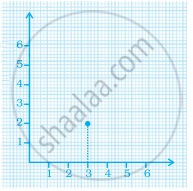
In the given graph the coordinates of point x are ______.
Options
(0, 2)
(2, 3)
(3, 2)
(3, 0)
Advertisements
Solution
In the given graph the coordinates of point x are (3, 2).
Explanation:
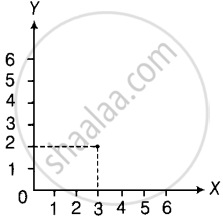
The foot of the perpendicular drawn from the indicated point on X-axis is at a distance of 3 units from the origin.
The x-coordinate of the point is 3.
Again, the perpendicular drawn from the given point on Y-axis meets the Y-axis at a point which is at a distance of 2 units from origin.
The y-coordinate of the point is 2.
Hence, the coordinates of the point are (3, 2).
APPEARS IN
RELATED QUESTIONS
A point which lies on both the axis is ______.
All points with y-coordinate as zero lie on the ______.
In the coordinates of a point, the second number denotes the ______.
The point where the two axes intersect is called the ______.
Plot the given points on a graph sheet and check if the points lie on a straight line. If not, name the shape they form when joined in the given order.
(4, 2), (2, 4), (3, 3), (5, 4)
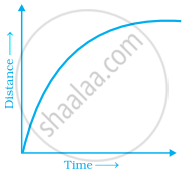
Explain the situations represented by the following distance-time graph.
The table shows the data collected for Dhruv’s walking on a road.
| Time (in minutes) |
0 | 5 | 10 | 15 | 20 | 25 |
| Distance (in km) |
0 | 0.5 | 1 | 1.25 | 1.5 | 1.75 |
- Plot a line graph for the given data using a suitable scale.
- In what time periods did Dhruv make the most progress?
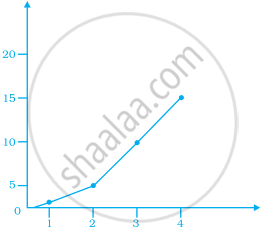
Observe the given graph carefully and complete the table given below.
| x | 1 | 2 | 3 | 4 | 5 |
| y |
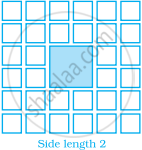
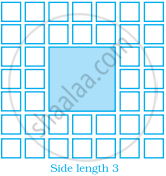
Sonal and Anmol made a sequence of tile designs from square white tiles surrounding one square purple tile. The purple tiles come in many sizes. Three of the designs are shown below.
(a) Copy and complete the table
| Side Length of Purple Titles | 1 | 2 | 3 | 4 | 5 | 10 | 100 |
| Number of white Tiles in Border |
 |
 |
 |
(b) Draw a graph using the first five pairs of numbers in your table.
(c) Do the points lie on a line?
