Advertisements
Advertisements
Question
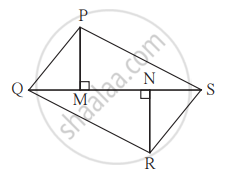
In the figure, PM = 10 cm, A(∆PQS) = 100 sq.cm, A(∆QRS) = 110 sq. cm, then find NR.
Advertisements
Solution
`{:("PM = 10 cm"), ("A(∆PQS) = 100 sq.cm"), ("A(∆QRS) = 110 sq.cm"):} }"Given"`
Now,
In ∆PQS and ∆QRS,
seg QS is common base of ∆PQS and ∆QRS.
∴ `"A(∆PQS)"/"A(∆QRS)" = "PM"/"NR"` ...(Triangles having equal base)
∴ `100/110 = 10/"NR"`
∴ `"NR" = (110 × 10)/100`
∴ NR = 11 cm
APPEARS IN
RELATED QUESTIONS
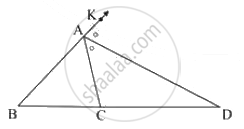
In the given figure, AD is the bisector of the exterior ∠A of ∆ABC. Seg AD intersects the side BC produced in D. Prove that:
In the given figure, BC ⊥ AB, AD ⊥ AB, BC = 4, AD = 8, then find `("A"(∆"ABC"))/("A"(∆"ADB"))`

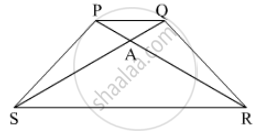
In trapezium PQRS, side PQ || side SR, AR = 5AP, AS = 5AQ then prove that, SR = 5PQ
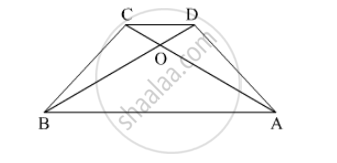
In trapezium ABCD, side AB || side DC, diagonals AC and BD intersect in point O. If AB = 20, DC = 6, OB = 15 then Find OD.
In ∆ABC, B - D - C and BD = 7, BC = 20 then find following ratio.
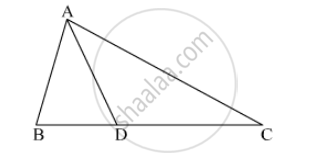
`"A(∆ ABD)"/"A(∆ ADC)"`
Ratio of areas of two triangles with equal heights is 2 : 3. If base of the smaller triangle is 6 cm then what is the corresponding base of the bigger triangle ?
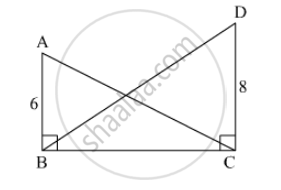
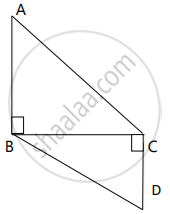
In the given figure, ∠ABC = ∠DCB = 90° AB = 6, DC = 8 then `(A(Δ ABC))/(A(Δ DCB))` = ?
The ratio of the areas of two triangles with the common base is 4 : 3. Height of the larger triangle is 2 cm, then find the corresponding height of the smaller triangle.
In ∆ABC, B – D – C and BD = 7, BC = 20, then find the following ratio.
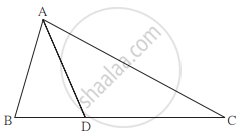
`(A(triangleABD))/(A(triangleABC))`
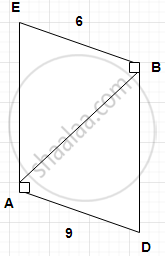
In the given, seg BE ⊥ seg AB and seg BA ⊥ seg AD.
if BE = 6 and AD = 9 find `(A(Δ ABE))/(A(Δ BAD))`.
A roller of diameter 0.9 m and the length 1.8 m is used to press the ground. Find the area of the ground pressed by it in 500 revolutions.
`(pi=3.14)`
If ΔXYZ ~ ΔPQR then `(XY)/(PQ) = (YZ)/(QR)` = ?
Ratio of corresponding sides of two similar triangles is 4 : 7, then find the ratio of their areas = ?
In fig., AB ⊥ BC and DC ⊥ BC, AB = 6, DC = 4 then `(A(ΔABC))/(A(ΔBCD))` = ?
In ΔABC, B-D-C and BD = 7, BC = 20, then find the following ratio.
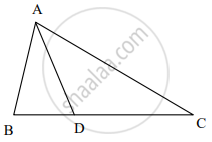
(i) `(A(ΔABD))/(A(ΔADC))`
(ii) `(A(ΔABD))/(A(ΔABC))`
(iii) `(A(ΔADC))/(A(ΔABC))`
Prove that, The areas of two triangles with the same height are in proportion to their corresponding bases. To prove this theorem start as follows:
- Draw two triangles, give the names of all points, and show heights.
- Write 'Given' and 'To prove' from the figure drawn.
