Advertisements
Advertisements
Question
The ratio of the areas of two triangles with the common base is 4 : 3. Height of the larger triangle is 2 cm, then find the corresponding height of the smaller triangle.
Advertisements
Solution
Let the height of the larger triangle be h1 and that of the smaller triangle be h2.
The ratio of the areas of two triangles with a common base is equal to the ratio of their corresponding heights.
`"Area(larger Triangle)"/"Area(smaller Triangle)"="h"_1/"h"_2`
`4/3=2/"h"_2`
`4xx "h"_2=3xx2`
`therefore"h"_2=(3xx2)/4=6/4`
`therefore"h"_2=1.5" cm"`
The corresponding height of the smaller triangle is 1.5 cm.
APPEARS IN
RELATED QUESTIONS
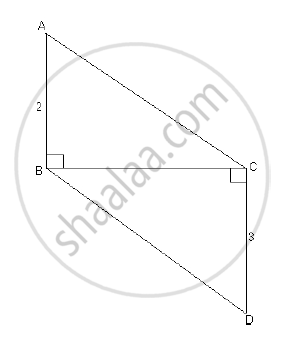
In the following figure seg AB ⊥ seg BC, seg DC ⊥ seg BC. If AB = 2 and DC = 3, find `(A(triangleABC))/(A(triangleDCB))`
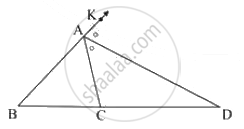
In the given figure, AD is the bisector of the exterior ∠A of ∆ABC. Seg AD intersects the side BC produced in D. Prove that:
In the given figure, BC ⊥ AB, AD ⊥ AB, BC = 4, AD = 8, then find `("A"(∆"ABC"))/("A"(∆"ADB"))`

In adjoining figure, PQ ⊥ BC, AD ⊥ BC then find following ratios.
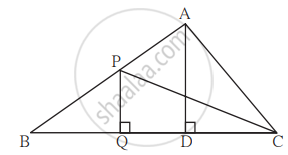
- `("A"(∆"PQB"))/("A"(∆"PBC"))`
- `("A"(∆"PBC"))/("A"(∆"ABC"))`
- `("A"(∆"ABC"))/("A"(∆"ADC"))`
- `("A"(∆"ADC"))/("A"(∆"PQC"))`
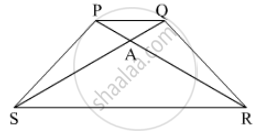
In trapezium PQRS, side PQ || side SR, AR = 5AP, AS = 5AQ then prove that, SR = 5PQ
In ∆ABC, B - D - C and BD = 7, BC = 20 then find following ratio.
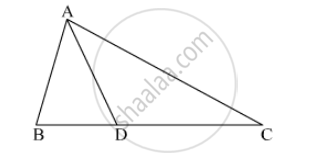
`"A(∆ ABD)"/"A(∆ ADC)"`
In ∆ABC, B – D – C and BD = 7, BC = 20, then find the following ratio.
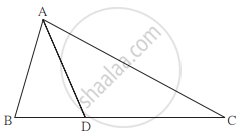
`(A(triangleABD))/(A(triangleABC))`
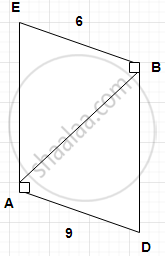
In the given, seg BE ⊥ seg AB and seg BA ⊥ seg AD.
if BE = 6 and AD = 9 find `(A(Δ ABE))/(A(Δ BAD))`.
A roller of diameter 0.9 m and the length 1.8 m is used to press the ground. Find the area of the ground pressed by it in 500 revolutions.
`(pi=3.14)`
If ΔXYZ ~ ΔPQR then `(XY)/(PQ) = (YZ)/(QR)` = ?
Ratio of corresponding sides of two similar triangles is 4 : 7, then find the ratio of their areas = ?
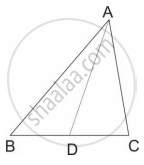
In fig. BD = 8, BC = 12, B-D-C, then `(A(ΔABC))/(A(ΔABD))` = ?
In fig., PM = 10 cm, A(ΔPQS) = 100 sq. cm, A(ΔQRS) = 110 sq. cm, then NR?
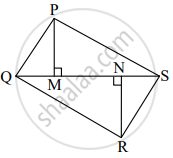
ΔPQS and ΔQRS having seg QS common base.
Areas of two triangles whose base is common are in proportion of their corresponding `square`.
`(A(ΔPQS))/(A(ΔQRS)) = (square)/(NR)`,
`100/110 = (square)/(NR)`,
NR = `square` cm
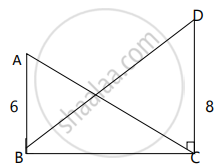
In fig., AB ⊥ BC and DC ⊥ BC, AB = 6, DC = 4 then `(A(ΔABC))/(A(ΔBCD))` = ?
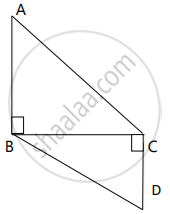
From adjoining figure, ∠ABC = 90°, ∠DCB = 90°, AB = 6, DC = 8, then `(A(ΔABC))/(A(ΔBCD))` = ?
In ΔABC, B-D-C and BD = 7, BC = 20, then find the following ratio.
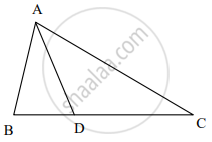
(i) `(A(ΔABD))/(A(ΔADC))`
(ii) `(A(ΔABD))/(A(ΔABC))`
(iii) `(A(ΔADC))/(A(ΔABC))`
Prove that, The areas of two triangles with the same height are in proportion to their corresponding bases. To prove this theorem start as follows:
- Draw two triangles, give the names of all points, and show heights.
- Write 'Given' and 'To prove' from the figure drawn.
