Advertisements
Advertisements
Question
In the figure given alongside, a narrow beam of white light is shown to pass through a triangular glass prism. After passing through the prism, it produces a spectrum YX on the screen.
Why do different colours of white light bend through different angles with respect to the incident beam of light?
Advertisements
Solution
Different colours of white light bend at different angles with respect to the incident beam of light. This is because different colours have different wavelength.
APPEARS IN
RELATED QUESTIONS
In the following diagram the correctly marked angles are :

(a) ∠A and ∠e
(b) ∠i, ∠A and ∠D
(c) ∠A ∠r and ∠e
(b) ∠A ∠r and ∠D
Draw a ray diagram to show the dispersion of white light.
In the formation of spectrum of white light by a prism:
which colour is deviated least?
Describe how you could demonstrate that white light is composed of a number of colours.
Which of the following coloured light has the least speed in glass prism?
(a) violet
(b) yellow
(c) red
(d) green
When white light passes through a prism, it ............
A ray of light moving from an optically rarer to a denser medium
In figure AO is the ray of white light falling on a prism PQR. Complete the diagram till the light emerges out from the prism and falls on the screen.
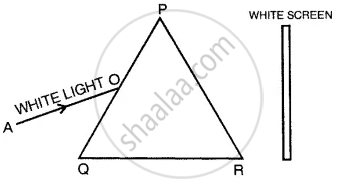
Explain the cause of dispersion of white light through a prism.
What conclusion do you draw about the nature of white light in part (b)?
Complete the ray diagram given below to show the nature of light produced on the screen.
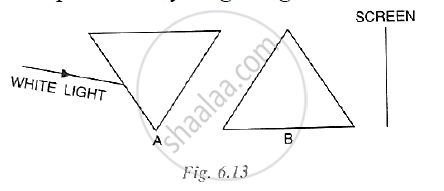
Differentiate between a glass slab and a glass prism.
State two properties of ultra-violet radiations which differ from visible light.
In the figure, a beam of light consisting of three colours blue, red, and yellow is incident on a prism and on a rectangular glass block respectively. Complete the diagram by drawings of the refracted and emergent rays.
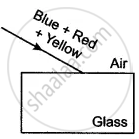
Write an Explanation.
Critical angle
The sunlight can be split into its constituent colors using ______.
What is dispersion? Explain in detail.
State the correct sequence (1-7) of colours in the spectrum formed by the prisms A and B, shown in the following figure.
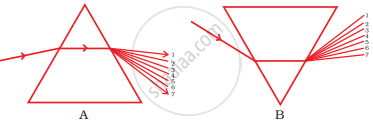
Make a rainbow
Try to make your own rainbow. You can try this project in the morning or in the evening. Stand with your back towards the Sun. Take a hosepipe or a water pipe used in the garden. Make a fine spray in front of you. You can see different colours of rainbow in the spray.
