Advertisements
Advertisements
Question
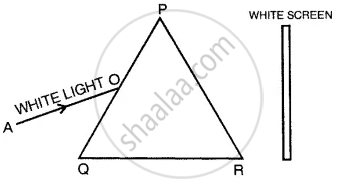
In figure AO is the ray of white light falling on a prism PQR. Complete the diagram till the light emerges out from the prism and falls on the screen.
Advertisements
Solution
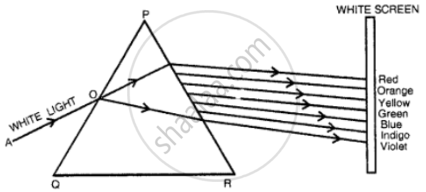
Diagram is completed:
‘The white light splits up into seven colours which are seen on the screen and arrangement of colours from bottom to top is given by the word ‘VIBGYOR’.
APPEARS IN
RELATED QUESTIONS
A student traces the path of a ray of light through a triangular glass prism for different values of angle of incidence. On analyzing the ray diagrams, which one of the following conclusions is he likely to draw?
(A) The emergent ray is parallel to the incident ray.
(B) The emergent ray bends at an angle to the direction of the incident ray.
(C) The emergent ray and the refracted ray are at right angles to each other.
(D) The emergent ray is perpendicular to the incident ray.
In the figure given alongside, a narrow beam of white light is shown to pass through a triangular glass prism. After passing through the prism, it produces a spectrum YX on the screen.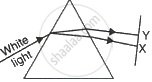
- State the colour seen
- at X, and
- at Y.
- Why do different colours of white light bend through different angles with respect to the incident beam of light?
Describe how you could demonstrate that white light is composed of a number of colours.
In an experiment to trace the path of a ray of light through a glass prism for different values of angle of incidence a student would find that the emergent ray:
(A) is parallel to the incident ray
(B) perpendicular to the incident ray
(C) is parallel to the refracted ray
(D) bends at an angle to the direction of incident ray
Differentiate between a glass slab and a glass prism.
State two properties of ultraviolet radiation which differ from visible light.
Which of the following is a natural phenomenon which is caused by the dispersion of sunlight in the sky?
The periscope is an optical device with a polished surface that reflects the light falling on it.
During dispersion of white light by prism placed in air, for a particular value of angle of prism,
