Advertisements
Advertisements
Question
State two properties of ultra-violet radiations which differ from visible light.
Advertisements
Solution
(i) Ultra-violet radiations are of wavelength shorter than that of visible light.
(ii) Ultra-violet radiations are more chemically active than the visible light.
RELATED QUESTIONS
Draw a ray diagram to show the dispersion of white light.
Explain the cause of dispersion of white light through a prism.
Draw a labeled ray diagram to illustrate the dispersion of a narrow beam of white light when it passes through a glass prism.
Make the correct choice for each of the following:
Which one of the following Fig correctly shows the path of the ray through the glass block?
A wave has wavelength 50Å of State the speed in vacuum.
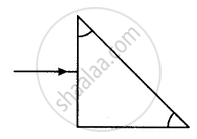
In the diagram, a narrow beam of white light is incident on a right-angled isosceles prism. The critical angle of the material of prism for the yellow colour of white light is 45°. Complete the diagram to show the path of blue, yellow, and red colours of white light till they emerge out of the prism.
Which one of the following is involved for the formation of rainbow in the sky?
The periscope is an optical device with a polished surface that reflects the light falling on it.
______ colour is deviated the least in the spectrum of white light obtained with a glass prism.
State True or False:
"Wavelength of red light is close to 700 nm.”
