Advertisements
Advertisements
Question
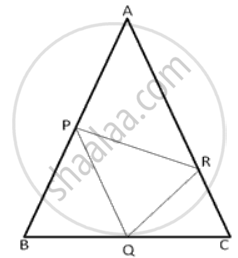
In ABC, P, Q and R are points on AB, BC and AC respectively. Prove that AB + BC + AC > PQ + QR + PR.
Advertisements
Solution
In triangle APR,
AP + AR > PR ......(i)
In triangle BPQ,
BQ + PB > PQ .......(ii)
In triangle QCR,
QC + CR > QR .......(iii)
Adding (i), (ii) and (iii)
AP + AR + BQ + PB + QC + CR > PR + PQ + QR
(AP + PB) + (BQ + QC) + (CR + AR) > PR + QR + PQ)
⇒ AB + BC + AC > PQ + QR + PR.
APPEARS IN
RELATED QUESTIONS
In the given figure, ∠B < ∠A and ∠C < ∠D. Show that AD < BC.

In the given figure, PR > PQ and PS bisects ∠QPR. Prove that ∠PSR >∠PSQ.

How had the position of women improved in our country since independence ? Explain with examples.
Arrange the sides of ∆BOC in descending order of their lengths. BO and CO are bisectors of angles ABC and ACB respectively.

In the following figure, write BC, AC, and CD in ascending order of their lengths.
“Caste inequalities are still prevalent in India.” Examine the statement.
"Issues of caste discrimination began to be written about in many printed tracts and essays in India in the late nineteenth century." Support the statement with two suitable examples.
Arrange the sides of the following triangles in an ascending order:
ΔABC, ∠A = 45°, ∠B = 65°.
In the given figure, ∠QPR = 50° and ∠PQR = 60°. Show that: SN < SR
In the given figure, T is a point on the side PR of an equilateral triangle PQR. Show that PT < QT
