Advertisements
Advertisements
प्रश्न
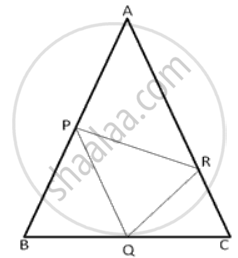
In ABC, P, Q and R are points on AB, BC and AC respectively. Prove that AB + BC + AC > PQ + QR + PR.
Advertisements
उत्तर
In triangle APR,
AP + AR > PR ......(i)
In triangle BPQ,
BQ + PB > PQ .......(ii)
In triangle QCR,
QC + CR > QR .......(iii)
Adding (i), (ii) and (iii)
AP + AR + BQ + PB + QC + CR > PR + PQ + QR
(AP + PB) + (BQ + QC) + (CR + AR) > PR + QR + PQ)
⇒ AB + BC + AC > PQ + QR + PR.
APPEARS IN
संबंधित प्रश्न
In the given figure sides AB and AC of ΔABC are extended to points P and Q respectively. Also, ∠PBC < ∠QCB. Show that AC > AB.

Complete the hexagonal and star shaped rangolies (see the given figures) by filling them with as many equilateral triangles of side 1 cm as you can. Count the number of triangles in each case. Which has more triangles?

In the following figure, ∠BAC = 60o and ∠ABC = 65o.

Prove that:
(i) CF > AF
(ii) DC > DF
Arrange the sides of the following triangles in an ascending order:
ΔDEF, ∠D = 38°, ∠E = 58°.
ΔABC is isosceles with AB = AC. If BC is extended to D, then prove that AD > AB.
D is a point on the side of the BC of ΔABC. Prove that the perimeter of ΔABC is greater than twice of AD.
ABCD is a trapezium. Prove that:
CD + DA + AB + BC > 2AC.
In the given figure, ∠QPR = 50° and ∠PQR = 60°. Show that : PN < RN
In the given figure, ∠QPR = 50° and ∠PQR = 60°. Show that: SN < SR
ΔABC in a isosceles triangle with AB = AC. D is a point on BC produced. ED intersects AB at E and AC at F. Prove that AF > AE.
