Advertisements
Advertisements
प्रश्न
In the given figure, PR > PQ and PS bisects ∠QPR. Prove that ∠PSR >∠PSQ.

Advertisements
उत्तर
As PR > PQ,
∴ ∠PQR > ∠PRQ (Angle opposite to larger side is larger) ... (1)
PS is the bisector of ∠QPR.
∴∠QPS = ∠RPS ... (2)
∠PSR is the exterior angle of ΔPQS.
∴ ∠PSR = ∠PQR + ∠QPS ... (3)
∠PSQ is the exterior angle of ΔPRS.
∴ ∠PSQ = ∠PRQ + ∠RPS ... (4)
Adding equations (1) and (2), we obtain
∠PQR + ∠QPS > ∠PRQ + ∠RPS
⇒ ∠PSR > ∠PSQ [Using the values of equations (3) and (4)]
संबंधित प्रश्न
In a triangle locate a point in its interior which is equidistant from all the sides of the triangle.
In the following figure, write BC, AC, and CD in ascending order of their lengths.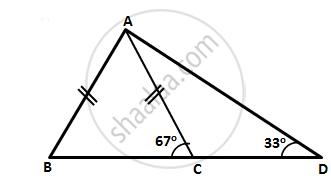
In the following figure, ∠BAC = 60o and ∠ABC = 65o.
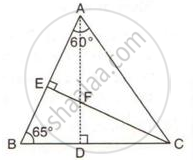
Prove that:
(i) CF > AF
(ii) DC > DF
Name the greatest and the smallest sides in the following triangles:
ΔABC, ∠ = 56°, ∠B = 64° and ∠C = 60°.
In ΔABC, the exterior ∠PBC > exterior ∠QCB. Prove that AB > AC.
In the given figure, ∠QPR = 50° and ∠PQR = 60°. Show that: SN < SR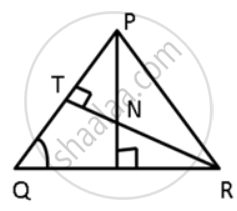
In ΔPQR, PS ⊥ QR ; prove that: PQ > QS and PR > PS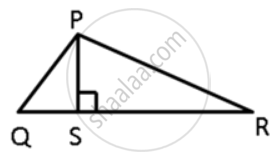
In the given figure, T is a point on the side PR of an equilateral triangle PQR. Show that PT < QT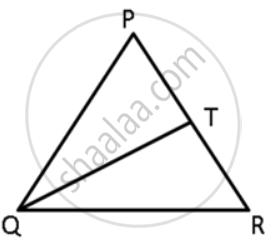
In the given figure, T is a point on the side PR of an equilateral triangle PQR. Show that RT < QT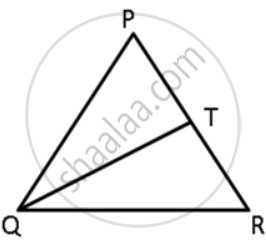
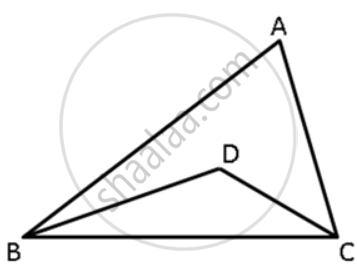
In ΔABC, D is a point in the interior of the triangle. Prove that DB + DC < AB + AC.