Advertisements
Advertisements
प्रश्न
ABCD is a trapezium. Prove that:
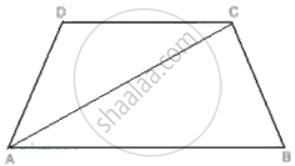
CD + DA + AB + BC > 2AC.
Advertisements
उत्तर
In ΔABC, we have
AB + BC > AC ...(i)
In ΔACD, we have
AD + CD > AC ...(ii)
Adding (i) and (ii), we get
AB + BC + AD + CD > 2AC.
APPEARS IN
संबंधित प्रश्न
ABC is a triangle. Locate a point in the interior of ΔABC which is equidistant from all the vertices of ΔABC.
In a triangle PQR; QR = PR and ∠P = 36o. Which is the largest side of the triangle?
Arrange the sides of ∆BOC in descending order of their lengths. BO and CO are bisectors of angles ABC and ACB respectively.

In the following figure, ∠BAC = 60o and ∠ABC = 65o.

Prove that:
(i) CF > AF
(ii) DC > DF
In the following figure ; AC = CD; ∠BAD = 110o and ∠ACB = 74o.
Prove that: BC > CD.
Name the greatest and the smallest sides in the following triangles:
ΔABC, ∠ = 56°, ∠B = 64° and ∠C = 60°.
In ΔABC, the exterior ∠PBC > exterior ∠QCB. Prove that AB > AC.
ΔABC is isosceles with AB = AC. If BC is extended to D, then prove that AD > AB.
ΔABC in a isosceles triangle with AB = AC. D is a point on BC produced. ED intersects AB at E and AC at F. Prove that AF > AE.
In ΔABC, AE is the bisector of ∠BAC. D is a point on AC such that AB = AD. Prove that BE = DE and ∠ABD > ∠C.
