Advertisements
Advertisements
प्रश्न
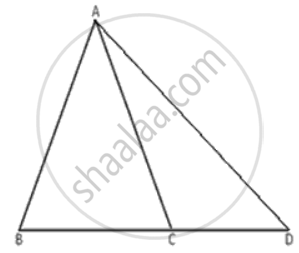
ΔABC is isosceles with AB = AC. If BC is extended to D, then prove that AD > AB.
Advertisements
उत्तर
Using the exterior angle and property in ΔACD, we have
∠ACB = ∠CDA + ∠CAD
⇒ ∠ACB > ∠CDA ------(1)
Now, AB = AC
Now, ∠ACB = ∠ABC ------(2)
From (1) and (2)
∠ABC > ∠CDA
It is known that, in a triangle, the greater angle has the longer side opposite to it.
Now, In ΔABD, er have ∠ABC > ∠CDA
∴ AD > AB.
APPEARS IN
संबंधित प्रश्न
From the following figure, prove that: AB > CD.

“Caste inequalities are still prevalent in India.” Examine the statement.
Name the greatest and the smallest sides in the following triangles:
ΔABC, ∠ = 56°, ∠B = 64° and ∠C = 60°.
Arrange the sides of the following triangles in an ascending order:
ΔABC, ∠A = 45°, ∠B = 65°.
Arrange the sides of the following triangles in an ascending order:
ΔDEF, ∠D = 38°, ∠E = 58°.
In ΔABC, the exterior ∠PBC > exterior ∠QCB. Prove that AB > AC.
Prove that the hypotenuse is the longest side in a right-angled triangle.
In ABC, P, Q and R are points on AB, BC and AC respectively. Prove that AB + BC + AC > PQ + QR + PR.
In ΔPQR, PS ⊥ QR ; prove that: PQ > QS and PQ > PS
ΔABC in a isosceles triangle with AB = AC. D is a point on BC produced. ED intersects AB at E and AC at F. Prove that AF > AE.
