Advertisements
Advertisements
प्रश्न
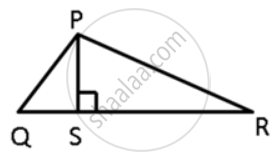
In ΔPQR, PS ⊥ QR ; prove that: PQ + PR > QR and PQ + QR >2PS.
Advertisements
उत्तर
In ΔPQR,
PQ + PR > QR (∵ Sum of two sides of a triangle is always greater than third aside.)
In ΔPQS,
PQ + QS > PS (∵ Sum of two sides of a triangle is always greater than third aside.) .....(i)
In ΔPRS,
PR + SR > PS (∵ Sum of two sides of a triangle is always greater than third aside.) .....(ii)
Adding (i) and (ii),
PQ + QS + PR + SR > 2PS
PQ + (QS + SR) + PR > 2PS
PQ + QR + PR > 2PS
Since PQ + PR > QR
⇒ PQ + QR > 2PS.
APPEARS IN
संबंधित प्रश्न
In a triangle locate a point in its interior which is equidistant from all the sides of the triangle.
How had the position of women improved in our country since independence ? Explain with examples.
D is a point in side BC of triangle ABC. If AD > AC, show that AB > AC.
Name the smallest angle in each of these triangles:
In ΔXYZ, XY = 6.2cm, XY = 6.8cm and YZ = 5cm
Prove that the hypotenuse is the longest side in a right-angled triangle.
ABCD is a trapezium. Prove that:
CD + DA + AB > BC.
In the given figure, ∠QPR = 50° and ∠PQR = 60°. Show that : PN < RN
In ΔPQR, PS ⊥ QR ; prove that: PQ > QS and PR > PS
In ΔABC, AE is the bisector of ∠BAC. D is a point on AC such that AB = AD. Prove that BE = DE and ∠ABD > ∠C.
In ΔABC, D is a point in the interior of the triangle. Prove that DB + DC < AB + AC.
