Advertisements
Advertisements
प्रश्न
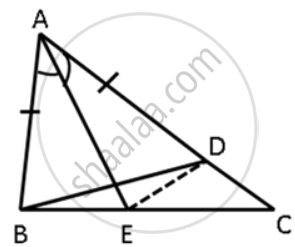
In ΔABC, AE is the bisector of ∠BAC. D is a point on AC such that AB = AD. Prove that BE = DE and ∠ABD > ∠C.
Advertisements
उत्तर
In the ΔABE and ΔADE,
AB = AD ....(Given)
∠BAE = ∠DAE ....(AE is the bisector of ∠BAC)
AE = AE ....(Common side)
∴ ΔABE ≅ ΔADE ....(SAS test)
⇒ BE = DE ....(c.p.c.t.c)
In ΔABD,
AB = AD
⇒ ∠ABD = ∠ADB
∠ADB > ∠C ...(Exterior angle property)
⇒ ∠ABD > ∠C.
APPEARS IN
संबंधित प्रश्न
ABC is a triangle. Locate a point in the interior of ΔABC which is equidistant from all the vertices of ΔABC.
In a huge park people are concentrated at three points (see the given figure):

A: where there are different slides and swings for children,
B: near which a man-made lake is situated,
C: which is near to a large parking and exit.
Where should an ice-cream parlour be set up so that maximum number of persons can approach it?
(Hint: The parlor should be equidistant from A, B and C)
Name the greatest and the smallest sides in the following triangles:
ΔXYZ, ∠X = 76°, ∠Y = 84°.
Arrange the sides of the following triangles in an ascending order:
ΔDEF, ∠D = 38°, ∠E = 58°.
ΔABC is isosceles with AB = AC. If BC is extended to D, then prove that AD > AB.
D is a point on the side of the BC of ΔABC. Prove that the perimeter of ΔABC is greater than twice of AD.
ABCD is a trapezium. Prove that:
CD + DA + AB + BC > 2AC.
In the given figure, ∠QPR = 50° and ∠PQR = 60°. Show that: SN < SR
In ΔABC, BC produced to D, such that, AC = CD; ∠BAD = 125° and ∠ACD = 105°. Show that BC > CD.
ΔABC in a isosceles triangle with AB = AC. D is a point on BC produced. ED intersects AB at E and AC at F. Prove that AF > AE.
