Advertisements
Advertisements
प्रश्न
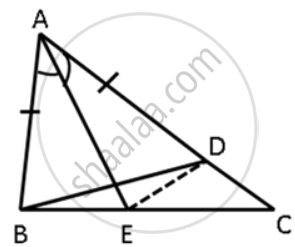
In ΔABC, AE is the bisector of ∠BAC. D is a point on AC such that AB = AD. Prove that BE = DE and ∠ABD > ∠C.
Advertisements
उत्तर
In the ΔABE and ΔADE,
AB = AD ....(Given)
∠BAE = ∠DAE ....(AE is the bisector of ∠BAC)
AE = AE ....(Common side)
∴ ΔABE ≅ ΔADE ....(SAS test)
⇒ BE = DE ....(c.p.c.t.c)
In ΔABD,
AB = AD
⇒ ∠ABD = ∠ADB
∠ADB > ∠C ...(Exterior angle property)
⇒ ∠ABD > ∠C.
APPEARS IN
संबंधित प्रश्न
AB and CD are respectively the smallest and longest sides of a quadrilateral ABCD (see the given figure). Show that ∠A > ∠C and ∠B > ∠D.

In a triangle locate a point in its interior which is equidistant from all the sides of the triangle.
“Caste inequalities are still prevalent in India.” Examine the statement.
ΔABC is isosceles with AB = AC. If BC is extended to D, then prove that AD > AB.
In ΔPQR, PR > PQ and T is a point on PR such that PT = PQ. Prove that QR > TR.
ABCD is a trapezium. Prove that:
CD + DA + AB + BC > 2AC.
In ΔPQR, PS ⊥ QR ; prove that: PQ > QS and PQ > PS
In ΔPQR is a triangle and S is any point in its interior. Prove that SQ + SR < PQ + PR.
Prove that in an isosceles triangle any of its equal sides is greater than the straight line joining the vertex to any point on the base of the triangle.
ΔABC in a isosceles triangle with AB = AC. D is a point on BC produced. ED intersects AB at E and AC at F. Prove that AF > AE.
