Advertisements
Advertisements
प्रश्न
In the given figure, ∠B < ∠A and ∠C < ∠D. Show that AD < BC.

Advertisements
उत्तर
In ΔAOB,
∠B < ∠A
⇒ AO < BO (Side opposite to smaller angle is smaller) ... (1)
In ΔCOD,
∠C < ∠D
⇒ OD < OC (Side opposite to smaller angle is smaller) ... (2)
On adding equations (1) and (2), we obtain
AO + OD < BO + OC
AD < BC
संबंधित प्रश्न
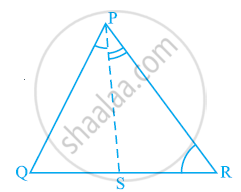
In the given figure, PR > PQ and PS bisects ∠QPR. Prove that ∠PSR >∠PSQ.
From the following figure, prove that: AB > CD.

Prove that the perimeter of a triangle is greater than the sum of its three medians.
D is a point on the side of the BC of ΔABC. Prove that the perimeter of ΔABC is greater than twice of AD.
ABCD is a quadrilateral in which the diagonals AC and BD intersect at O. Prove that AB + BC + CD + AD < 2(AC + BC).
ABCD is a trapezium. Prove that: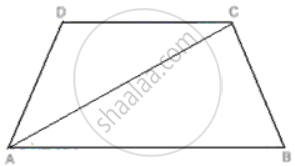
CD + DA + AB > BC.
In the given figure, ∠QPR = 50° and ∠PQR = 60°. Show that: SN < SR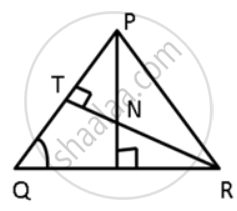
In ΔPQR, PS ⊥ QR ; prove that: PQ > QS and PR > PS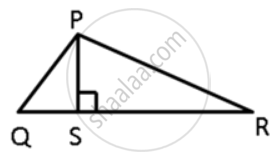
In the given figure, T is a point on the side PR of an equilateral triangle PQR. Show that PT < QT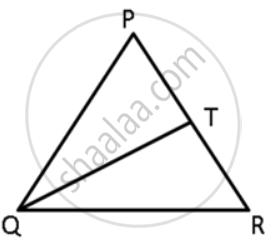
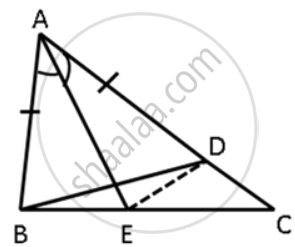
In ΔABC, AE is the bisector of ∠BAC. D is a point on AC such that AB = AD. Prove that BE = DE and ∠ABD > ∠C.