Advertisements
Advertisements
प्रश्न
Show that in a right angled triangle, the hypotenuse is the longest side.
Advertisements
उत्तर
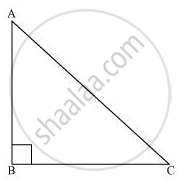
Let us consider a right-angled triangle ABC, right-angled at B.
In ΔABC,
∠A + ∠B + ∠C = 180° ...(Angle sum property of a triangle)
∠A + 90º + ∠C = 180°
∠A + ∠C = 90°
Hence, the other two angles have to be acute i.e., less than 90º.
∴ ∠B is the largest angle in ΔABC.
⇒ ∠B > ∠A and ∠B > ∠C
⇒ AC > BC and AC > AB
In any triangle, the side opposite to the larger (greater) angle is longer.
Therefore, AC is the largest side in ΔABC.
However, AC is the hypotenuse of ΔABC.
Therefore, hypotenuse is the longest side in a right-angled triangle.
APPEARS IN
संबंधित प्रश्न
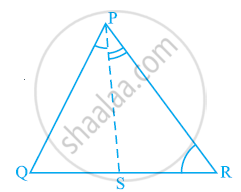
In the given figure, PR > PQ and PS bisects ∠QPR. Prove that ∠PSR >∠PSQ.
Show that of all line segments drawn from a given point not on it, the perpendicular line segment is the shortest.
In the following figure ; AC = CD; ∠BAD = 110o and ∠ACB = 74o.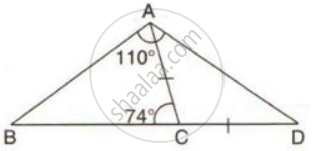
Prove that: BC > CD.
“Caste inequalities are still prevalent in India.” Examine the statement.
Name the smallest angle in each of these triangles:
In ΔPQR, PQ = 8.3cm, QR = 5.4cm and PR = 7.2cm
D is a point on the side of the BC of ΔABC. Prove that the perimeter of ΔABC is greater than twice of AD.
ABCD is a trapezium. Prove that: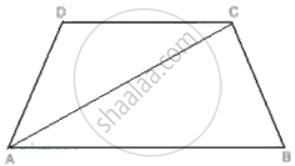
CD + DA + AB + BC > 2AC.
In ΔPQR, PS ⊥ QR ; prove that: PQ > QS and PQ > PS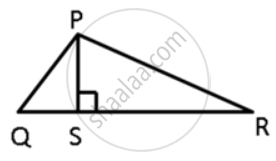
Prove that in an isosceles triangle any of its equal sides is greater than the straight line joining the vertex to any point on the base of the triangle.
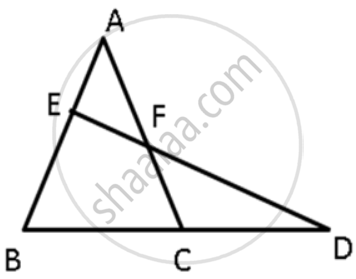
ΔABC in a isosceles triangle with AB = AC. D is a point on BC produced. ED intersects AB at E and AC at F. Prove that AF > AE.