Advertisements
Advertisements
प्रश्न
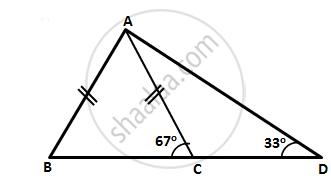
In the following figure, write BC, AC, and CD in ascending order of their lengths.
Advertisements
उत्तर

In ΔABC,
AB = AC
⇒ ∠ABC = ∠ACB ..(angles opposite to equal sides are equal)
⇒ ∠ABC = ∠ACB = 67°
⇒ ∠BAC = 180° - ∠ABC - ∠ACB ...(Angle sum property)
⇒ ∠BAC = 180° - 67° - 67°
⇒ ∠BAC = 46°
Since ∠BAC < ∠ABC, we have
BC < AC ...(1)
Now, ∠ACD = 180° - ACB ...(Linear pair)
⇒ ∠ACD = 180° - 67°
⇒ ∠ACD = 113°
Thus, in ΔACD,
∠CAD = 180°- ∠ACD + ∠ADC
⇒ ∠CAD = 180° - (113° + 33°)
⇒ ∠CAD = 180° - 146°
⇒ ∠CAD = 34°
Since ∠ADC < ∠CAD, we have
AC < CD ...(2)
From (1) and (2), we have
BC < AC < CD
संबंधित प्रश्न
ABC is a triangle. Locate a point in the interior of ΔABC which is equidistant from all the vertices of ΔABC.
In a triangle locate a point in its interior which is equidistant from all the sides of the triangle.
Name the greatest and the smallest sides in the following triangles:
ΔABC, ∠ = 56°, ∠B = 64° and ∠C = 60°.
Name the smallest angle in each of these triangles:
In ΔABC, AB = 6.2cm, BC = 5.6cm and AC = 4.2cm
Name the smallest angle in each of these triangles:
In ΔPQR, PQ = 8.3cm, QR = 5.4cm and PR = 7.2cm
In ABC, P, Q and R are points on AB, BC and AC respectively. Prove that AB + BC + AC > PQ + QR + PR.
In ΔPQR, PR > PQ and T is a point on PR such that PT = PQ. Prove that QR > TR.
In the given figure, ∠QPR = 50° and ∠PQR = 60°. Show that : PN < RN
In ΔPQR, PS ⊥ QR ; prove that: PQ > QS and PR > PS
Prove that in an isosceles triangle any of its equal sides is greater than the straight line joining the vertex to any point on the base of the triangle.
