Advertisements
Advertisements
Question
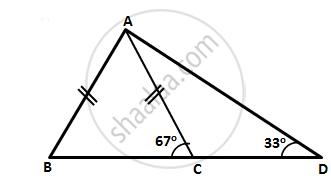
In the following figure, write BC, AC, and CD in ascending order of their lengths.
Advertisements
Solution

In ΔABC,
AB = AC
⇒ ∠ABC = ∠ACB ..(angles opposite to equal sides are equal)
⇒ ∠ABC = ∠ACB = 67°
⇒ ∠BAC = 180° - ∠ABC - ∠ACB ...(Angle sum property)
⇒ ∠BAC = 180° - 67° - 67°
⇒ ∠BAC = 46°
Since ∠BAC < ∠ABC, we have
BC < AC ...(1)
Now, ∠ACD = 180° - ACB ...(Linear pair)
⇒ ∠ACD = 180° - 67°
⇒ ∠ACD = 113°
Thus, in ΔACD,
∠CAD = 180°- ∠ACD + ∠ADC
⇒ ∠CAD = 180° - (113° + 33°)
⇒ ∠CAD = 180° - 146°
⇒ ∠CAD = 34°
Since ∠ADC < ∠CAD, we have
AC < CD ...(2)
From (1) and (2), we have
BC < AC < CD
APPEARS IN
RELATED QUESTIONS
Show that in a right angled triangle, the hypotenuse is the longest side.
ABC is a triangle. Locate a point in the interior of ΔABC which is equidistant from all the vertices of ΔABC.
In the following figure, write BC, AC, and CD in ascending order of their lengths.
“Caste inequalities are still prevalent in India.” Examine the statement.
Name the greatest and the smallest sides in the following triangles:
ΔABC, ∠ = 56°, ∠B = 64° and ∠C = 60°.
Arrange the sides of the following triangles in an ascending order:
ΔDEF, ∠D = 38°, ∠E = 58°.
In ΔABC, the exterior ∠PBC > exterior ∠QCB. Prove that AB > AC.
ABCD is a trapezium. Prove that:
CD + DA + AB > BC.
In ΔABC, AE is the bisector of ∠BAC. D is a point on AC such that AB = AD. Prove that BE = DE and ∠ABD > ∠C.
In ΔABC, D is a point in the interior of the triangle. Prove that DB + DC < AB + AC.
