Advertisements
Advertisements
Question
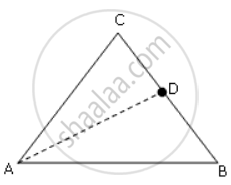
D is a point on the side of the BC of ΔABC. Prove that the perimeter of ΔABC is greater than twice of AD.
Advertisements
Solution

Construction: Join AD
In triangle ACD,
AC + CD > AD ...(i)
(Sum of two of a triangle greater than the third side)
Similarly, in triangle ADB,
AB + BD > AD ...(ii)
Adding (i) and (ii),
AC + CD + AB + BD > AD
AB + BC + AC > 2AD. ...(Since, CD + BD = BC)
APPEARS IN
RELATED QUESTIONS
In the given figure sides AB and AC of ΔABC are extended to points P and Q respectively. Also, ∠PBC < ∠QCB. Show that AC > AB.

In the given figure, ∠B < ∠A and ∠C < ∠D. Show that AD < BC.

AB and CD are respectively the smallest and longest sides of a quadrilateral ABCD (see the given figure). Show that ∠A > ∠C and ∠B > ∠D.

If two sides of a triangle are 8 cm and 13 cm, then the length of the third side is between a cm and b cm. Find the values of a and b such that a is less than b.
In the following figure, write BC, AC, and CD in ascending order of their lengths.
Arrange the sides of ∆BOC in descending order of their lengths. BO and CO are bisectors of angles ABC and ACB respectively.

D is a point in side BC of triangle ABC. If AD > AC, show that AB > AC.
In the following figure ; AC = CD; ∠BAD = 110o and ∠ACB = 74o.
Prove that: BC > CD.
In ΔPQR, PS ⊥ QR ; prove that: PQ + PR > QR and PQ + QR >2PS.
ΔABC in a isosceles triangle with AB = AC. D is a point on BC produced. ED intersects AB at E and AC at F. Prove that AF > AE.