Advertisements
Advertisements
Question
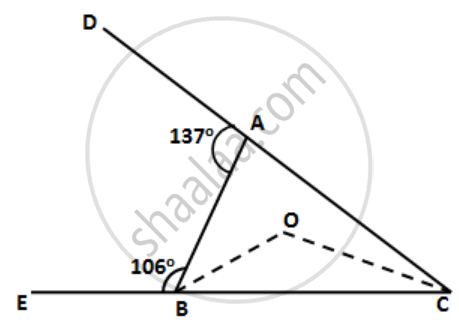
Arrange the sides of ∆BOC in descending order of their lengths. BO and CO are bisectors of angles ABC and ACB respectively.
Advertisements
Solution

∠BAC = 180° - ∠BAD = 180° - 137° = 43°
∠ABC = 180° - ∠ABE = 180° - 106° = 74°
Thus, in ΔABC,
∠ACB = 180° - ∠BAC - ∠ABC
⇒ ∠ACB = 180° - 43° - 74° = 63°
Now, ∠ABC = ∠OBC + ∠ABO
⇒ ∠ABC = 2∠OBC ....( OB is biosector of ∠ABC )
⇒ 74° = 2∠OBC
⇒ ∠OBC = 37°
Similarly,
∠ACB = ∠OCB + ∠ACO
⇒ ∠ACB = 2∠OCB ...( OC is bisector of ACB )
⇒ 63° = 2∠OCB
⇒ ∠OCB = 31.5°
Now, in ΔBOC,
∠BOC = 180° - ∠OBC - ∠OCB
⇒ ∠BOC = 180° - 37° - 31.5°
⇒ ∠BOC = 111.5°
Since, ∠BOC> ∠OBC > ∠OCB, we have
BC > OC > OB
APPEARS IN
RELATED QUESTIONS
ABC is a triangle. Locate a point in the interior of ΔABC which is equidistant from all the vertices of ΔABC.
In the following figure, write BC, AC, and CD in ascending order of their lengths.
Name the greatest and the smallest sides in the following triangles:
ΔXYZ, ∠X = 76°, ∠Y = 84°.
ΔABC is isosceles with AB = AC. If BC is extended to D, then prove that AD > AB.
Prove that the perimeter of a triangle is greater than the sum of its three medians.
ABCD is a quadrilateral in which the diagonals AC and BD intersect at O. Prove that AB + BC + CD + AD < 2(AC + BC).
In the given figure, ∠QPR = 50° and ∠PQR = 60°. Show that : PN < RN
In ΔPQR, PS ⊥ QR ; prove that: PQ > QS and PR > PS
In the given figure, T is a point on the side PR of an equilateral triangle PQR. Show that PT < QT
ΔABC in a isosceles triangle with AB = AC. D is a point on BC produced. ED intersects AB at E and AC at F. Prove that AF > AE.
