Advertisements
Advertisements
प्रश्न
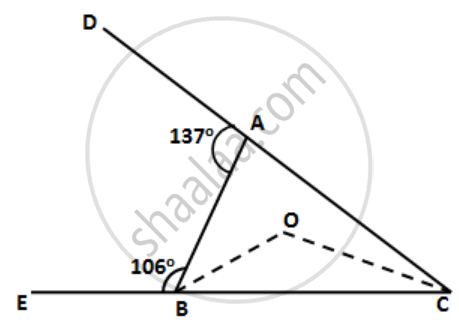
Arrange the sides of ∆BOC in descending order of their lengths. BO and CO are bisectors of angles ABC and ACB respectively.
Advertisements
उत्तर

∠BAC = 180° - ∠BAD = 180° - 137° = 43°
∠ABC = 180° - ∠ABE = 180° - 106° = 74°
Thus, in ΔABC,
∠ACB = 180° - ∠BAC - ∠ABC
⇒ ∠ACB = 180° - 43° - 74° = 63°
Now, ∠ABC = ∠OBC + ∠ABO
⇒ ∠ABC = 2∠OBC ....( OB is biosector of ∠ABC )
⇒ 74° = 2∠OBC
⇒ ∠OBC = 37°
Similarly,
∠ACB = ∠OCB + ∠ACO
⇒ ∠ACB = 2∠OCB ...( OC is bisector of ACB )
⇒ 63° = 2∠OCB
⇒ ∠OCB = 31.5°
Now, in ΔBOC,
∠BOC = 180° - ∠OBC - ∠OCB
⇒ ∠BOC = 180° - 37° - 31.5°
⇒ ∠BOC = 111.5°
Since, ∠BOC> ∠OBC > ∠OCB, we have
BC > OC > OB
APPEARS IN
संबंधित प्रश्न
Show that of all line segments drawn from a given point not on it, the perpendicular line segment is the shortest.
ABC is a triangle. Locate a point in the interior of ΔABC which is equidistant from all the vertices of ΔABC.
From the following figure, prove that: AB > CD.

Name the greatest and the smallest sides in the following triangles:
ΔDEF, ∠D = 32°, ∠E = 56° and ∠F = 92°.
Arrange the sides of the following triangles in an ascending order:
ΔDEF, ∠D = 38°, ∠E = 58°.
Name the smallest angle in each of these triangles:
In ΔPQR, PQ = 8.3cm, QR = 5.4cm and PR = 7.2cm
In ΔABC, the exterior ∠PBC > exterior ∠QCB. Prove that AB > AC.
ΔABC is isosceles with AB = AC. If BC is extended to D, then prove that AD > AB.
In ABC, P, Q and R are points on AB, BC and AC respectively. Prove that AB + BC + AC > PQ + QR + PR.
In the given figure, ∠QPR = 50° and ∠PQR = 60°. Show that: SN < SR
