Advertisements
Advertisements
Question
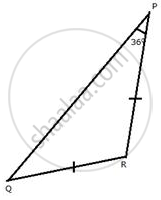
In a triangle PQR; QR = PR and ∠P = 36o. Which is the largest side of the triangle?
Advertisements
Solution

In ΔPQR,
QR = PR ...[ Given ]
∴ ∠P = ∠Q ...[ angles opposite to equal sides are equal ]
⇒ ∠P = 36° ..[Given]
⇒ ∠Q = 36°
In ΔPQR,
∠P + ∠Q + ∠R = 180°
⇒ 36° + 36° + ∠R = 180°
⇒ ∠R + 72° = 180°
⇒ ∠R = 108°
Now,
∠R = 108°
∠P = 36°
∠Q = 36°
Since ∠R is the greatest, therefore, PQ is the largest side.
APPEARS IN
RELATED QUESTIONS
Show that of all line segments drawn from a given point not on it, the perpendicular line segment is the shortest.
In a triangle locate a point in its interior which is equidistant from all the sides of the triangle.
In a huge park people are concentrated at three points (see the given figure):

A: where there are different slides and swings for children,
B: near which a man-made lake is situated,
C: which is near to a large parking and exit.
Where should an ice-cream parlour be set up so that maximum number of persons can approach it?
(Hint: The parlor should be equidistant from A, B and C)
In the following figure ; AC = CD; ∠BAD = 110o and ∠ACB = 74o.
Prove that: BC > CD.
“Caste inequalities are still prevalent in India.” Examine the statement.
Name the smallest angle in each of these triangles:
In ΔPQR, PQ = 8.3cm, QR = 5.4cm and PR = 7.2cm
ABCD is a quadrilateral in which the diagonals AC and BD intersect at O. Prove that AB + BC + CD + AD < 2(AC + BC).
In ΔPQR, PR > PQ and T is a point on PR such that PT = PQ. Prove that QR > TR.
In the given figure, ∠QPR = 50° and ∠PQR = 60°. Show that : PN < RN
In ΔPQR, PS ⊥ QR ; prove that: PQ + PR > QR and PQ + QR >2PS.