Advertisements
Advertisements
प्रश्न
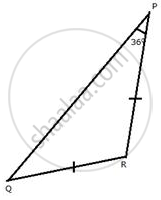
In a triangle PQR; QR = PR and ∠P = 36o. Which is the largest side of the triangle?
Advertisements
उत्तर

In ΔPQR,
QR = PR ...[ Given ]
∴ ∠P = ∠Q ...[ angles opposite to equal sides are equal ]
⇒ ∠P = 36° ..[Given]
⇒ ∠Q = 36°
In ΔPQR,
∠P + ∠Q + ∠R = 180°
⇒ 36° + 36° + ∠R = 180°
⇒ ∠R + 72° = 180°
⇒ ∠R = 108°
Now,
∠R = 108°
∠P = 36°
∠Q = 36°
Since ∠R is the greatest, therefore, PQ is the largest side.
APPEARS IN
संबंधित प्रश्न
In the given figure, PR > PQ and PS bisects ∠QPR. Prove that ∠PSR >∠PSQ.

Show that of all line segments drawn from a given point not on it, the perpendicular line segment is the shortest.
From the following figure, prove that: AB > CD.

In the following figure ; AC = CD; ∠BAD = 110o and ∠ACB = 74o.
Prove that: BC > CD.
Name the greatest and the smallest sides in the following triangles:
ΔABC, ∠ = 56°, ∠B = 64° and ∠C = 60°.
Name the greatest and the smallest sides in the following triangles:
ΔXYZ, ∠X = 76°, ∠Y = 84°.
Arrange the sides of the following triangles in an ascending order:
ΔABC, ∠A = 45°, ∠B = 65°.
ΔABC is isosceles with AB = AC. If BC is extended to D, then prove that AD > AB.
Prove that the hypotenuse is the longest side in a right-angled triangle.
In ΔPQR, PS ⊥ QR ; prove that: PQ > QS and PR > PS