Advertisements
Advertisements
प्रश्न
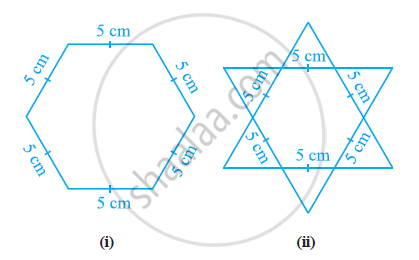
Complete the hexagonal and star shaped rangolies (see the given figures) by filling them with as many equilateral triangles of side 1 cm as you can. Count the number of triangles in each case. Which has more triangles?
Advertisements
उत्तर
It can be observed that hexagonal-shaped rangoli has 6 equilateral triangles in it.
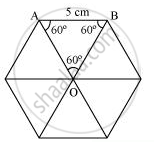
`"Area of "ΔOAB = sqrt3/4"(side)"^2`
`= sqrt3/4(5)^2`
`= sqrt3/4(25)`
`= (25sqrt3)/4cm^2`
`"Area of hexagonal-shaped rangoli "=6xx(25sqrt3)/4=(75sqrt3)/2cm^2`
`"Area of equilateral triangle having its side as 1cm "=sqrt3/4(1)^2=sqrt3/4cm^2`
`"Number of equilateral triangles of 1 cm side that can be filled in this hexagonal-shaped rangoli "=((75sqrt3)/2)/(sqrt3/4)=150`
Star-shaped rangoli has 12 equilateral triangles of side 5 cm in it.
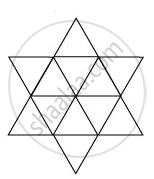
`"Area of star-shaped rangoli "=12xxsqrt3/4xx(5)^2=75sqrt3`
`"Number of equilateral triangles of 1 cm side that can be filled in this star-shaped rangoli "=(75sqrt3)/(sqrt3/4)=300`
Therefore, star-shaped rangoli has more equilateral triangles in it.
संबंधित प्रश्न
Show that in a right angled triangle, the hypotenuse is the longest side.
In a triangle PQR; QR = PR and ∠P = 36o. Which is the largest side of the triangle?
“Caste inequalities are still prevalent in India.” Examine the statement.
Name the smallest angle in each of these triangles:
In ΔABC, AB = 6.2cm, BC = 5.6cm and AC = 4.2cm
Name the smallest angle in each of these triangles:
In ΔPQR, PQ = 8.3cm, QR = 5.4cm and PR = 7.2cm
Name the smallest angle in each of these triangles:
In ΔXYZ, XY = 6.2cm, XY = 6.8cm and YZ = 5cm
In ΔABC, the exterior ∠PBC > exterior ∠QCB. Prove that AB > AC.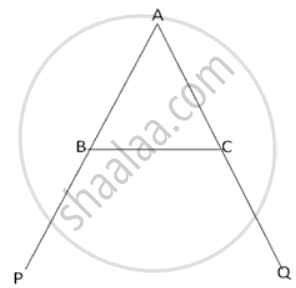
D is a point on the side of the BC of ΔABC. Prove that the perimeter of ΔABC is greater than twice of AD.
In the given figure, T is a point on the side PR of an equilateral triangle PQR. Show that RT < QT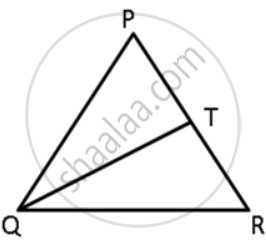
Prove that in an isosceles triangle any of its equal sides is greater than the straight line joining the vertex to any point on the base of the triangle.
