Advertisements
Advertisements
प्रश्न
In a triangle locate a point in its interior which is equidistant from all the sides of the triangle.
Advertisements
उत्तर
The point which is equidistant from all the sides of a triangle is called the incentre of the triangle. Incentre of a triangle is the intersection point of the angle bisectors of the interior angles of that triangle.
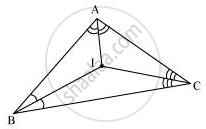
Here, in ΔABC, we can find the incentre of this triangle by drawing the angle bisectors of the interior angles of this triangle. I is the point where these angle bisectors are intersecting each other. Therefore, I is the point equidistant from all the sides of ΔABC.
संबंधित प्रश्न
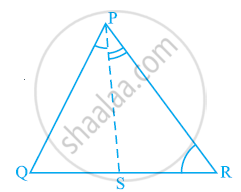
In the given figure, PR > PQ and PS bisects ∠QPR. Prove that ∠PSR >∠PSQ.
From the following figure, prove that: AB > CD.

In the following figure, write BC, AC, and CD in ascending order of their lengths.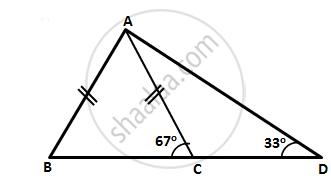
In the following figure, ∠BAC = 60o and ∠ABC = 65o.
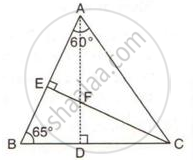
Prove that:
(i) CF > AF
(ii) DC > DF
Arrange the sides of the following triangles in an ascending order:
ΔABC, ∠A = 45°, ∠B = 65°.
Prove that the hypotenuse is the longest side in a right-angled triangle.
ABCD is a trapezium. Prove that: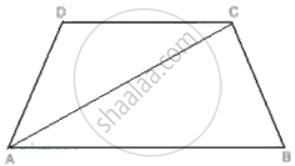
CD + DA + AB + BC > 2AC.
In the given figure, T is a point on the side PR of an equilateral triangle PQR. Show that RT < QT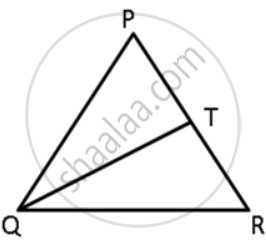
In ΔABC, AE is the bisector of ∠BAC. D is a point on AC such that AB = AD. Prove that BE = DE and ∠ABD > ∠C.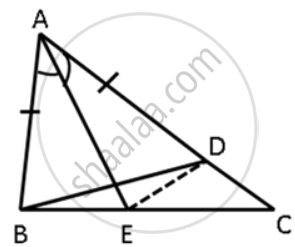
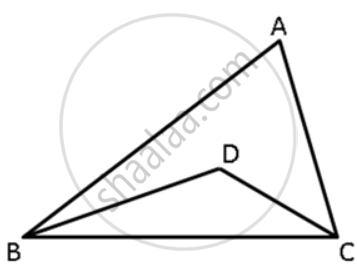
In ΔABC, D is a point in the interior of the triangle. Prove that DB + DC < AB + AC.