Advertisements
Advertisements
प्रश्न
In the following figure ; AC = CD; ∠BAD = 110o and ∠ACB = 74o.
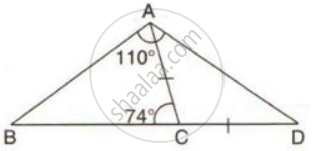
Prove that: BC > CD.
Advertisements
उत्तर
∠ACB = 74° ...(i)[ Given ]
∠ACB + ∠ACD = 180° ....[ BCD is a straight line ]
⇒ 74° + ∠ACD = 180°
⇒ ∠ACD = 106° …..(ii)
In ΔACD,
∠ACD + ∠ADC+ ∠CAD = 180°
Given that AC = CD
⇒ ∠ADC= ∠CAD
⇒ 106° + ∠CAD + ∠CAD = 180° ....[From (ii)]
⇒ 2∠CAD = 74°
⇒ ∠CAD = 37° = ∠ADC ...(iii)
Now,
∠BAD = 110° ....[Given]
∠BAC + ∠CAD = 110°
∠BAC + 37° = 110°
∠ BAC = 73° ….(iv)
In ABC,
∠ B + ∠BAC + ∠ACB = 180°
∠B + 73° + 74° = 180° ...[From (i) and (iv)]
∠B + 147°= 180°
∠B = 33° …..(v)
∴ ∠BAC > ∠B ...[ From (iv) and (v)]
⇒ BC > AC
But,
AC = CD ...[ Given ]
⇒ BC > CD
APPEARS IN
संबंधित प्रश्न
In a triangle locate a point in its interior which is equidistant from all the sides of the triangle.
In a huge park people are concentrated at three points (see the given figure):

A: where there are different slides and swings for children,
B: near which a man-made lake is situated,
C: which is near to a large parking and exit.
Where should an ice-cream parlour be set up so that maximum number of persons can approach it?
(Hint: The parlor should be equidistant from A, B and C)
In a triangle PQR; QR = PR and ∠P = 36o. Which is the largest side of the triangle?
In the following figure, write BC, AC, and CD in ascending order of their lengths.
Arrange the sides of the following triangles in an ascending order:
ΔDEF, ∠D = 38°, ∠E = 58°.
ABCD is a quadrilateral in which the diagonals AC and BD intersect at O. Prove that AB + BC + CD + AD < 2(AC + BC).
ABCD is a trapezium. Prove that:
CD + DA + AB > BC.
In the given figure, ∠QPR = 50° and ∠PQR = 60°. Show that: SN < SR
In ΔPQR, PS ⊥ QR ; prove that: PQ > QS and PR > PS
In ΔABC, AE is the bisector of ∠BAC. D is a point on AC such that AB = AD. Prove that BE = DE and ∠ABD > ∠C.
