Advertisements
Advertisements
प्रश्न
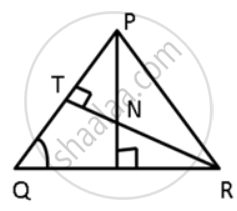
In the given figure, ∠QPR = 50° and ∠PQR = 60°. Show that: SN < SR
Advertisements
उत्तर
In ΔRTQ,
∠RTQ + ∠TQR + ∠TRQ = 180°
90° + 60° +∠TRQ = 180°
150° + ∠TRQ = 180°
∠TRQ = 180° - 150°
∠TRQ = 30°
∠TRQ = ∠SRN = 30° ....(i)
In NSR,
∠RNS + ∠SRN = 90° ....(∵∠NSR = 90°)
∠RNS + 30° = 90° ....[from (iii)]
∠RNS = 90° - 30°
∠RNS = 60° ....(ii)
∠SRN < ∠RNS ....(from (iii) and (iv))
SN < SR.
APPEARS IN
संबंधित प्रश्न
In a triangle PQR; QR = PR and ∠P = 36o. Which is the largest side of the triangle?
In the following figure, ∠BAC = 60o and ∠ABC = 65o.

Prove that:
(i) CF > AF
(ii) DC > DF
In the following figure, write BC, AC, and CD in ascending order of their lengths.
Arrange the sides of the following triangles in an ascending order:
ΔDEF, ∠D = 38°, ∠E = 58°.
In a triangle ABC, BC = AC and ∠ A = 35°. Which is the smallest side of the triangle?
ABCD is a quadrilateral in which the diagonals AC and BD intersect at O. Prove that AB + BC + CD + AD < 2(AC + BC).
In ΔPQR, PS ⊥ QR ; prove that: PQ > QS and PQ > PS
In ΔPQR, PS ⊥ QR ; prove that: PQ + PR > QR and PQ + QR >2PS.
In the given figure, T is a point on the side PR of an equilateral triangle PQR. Show that RT < QT
ΔABC in a isosceles triangle with AB = AC. D is a point on BC produced. ED intersects AB at E and AC at F. Prove that AF > AE.
