Advertisements
Advertisements
Question
ABCD is a trapezium. Prove that:
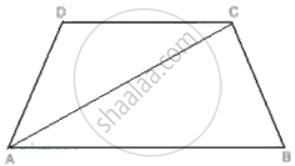
CD + DA + AB + BC > 2AC.
Advertisements
Solution
In ΔABC, we have
AB + BC > AC ...(i)
In ΔACD, we have
AD + CD > AC ...(ii)
Adding (i) and (ii), we get
AB + BC + AD + CD > 2AC.
APPEARS IN
RELATED QUESTIONS
AB and CD are respectively the smallest and longest sides of a quadrilateral ABCD (see the given figure). Show that ∠A > ∠C and ∠B > ∠D.

Show that of all line segments drawn from a given point not on it, the perpendicular line segment is the shortest.
Complete the hexagonal and star shaped rangolies (see the given figures) by filling them with as many equilateral triangles of side 1 cm as you can. Count the number of triangles in each case. Which has more triangles?

If two sides of a triangle are 8 cm and 13 cm, then the length of the third side is between a cm and b cm. Find the values of a and b such that a is less than b.
Name the smallest angle in each of these triangles:
In ΔABC, AB = 6.2cm, BC = 5.6cm and AC = 4.2cm
Name the smallest angle in each of these triangles:
In ΔPQR, PQ = 8.3cm, QR = 5.4cm and PR = 7.2cm
ΔABC is isosceles with AB = AC. If BC is extended to D, then prove that AD > AB.
In the given figure, T is a point on the side PR of an equilateral triangle PQR. Show that PT < QT
Prove that in an isosceles triangle any of its equal sides is greater than the straight line joining the vertex to any point on the base of the triangle.
ΔABC in a isosceles triangle with AB = AC. D is a point on BC produced. ED intersects AB at E and AC at F. Prove that AF > AE.
