Advertisements
Advertisements
Question
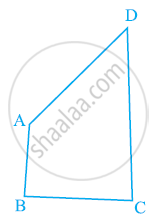
AB and CD are respectively the smallest and longest sides of a quadrilateral ABCD (see the given figure). Show that ∠A > ∠C and ∠B > ∠D.
Advertisements
Solution
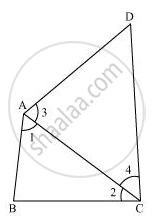
Let us join AC.
In ΔABC,
AB < BC (AB is the smallest side of quadrilateral ABCD)
∴ ∠2 < ∠1 (Angle opposite to the smaller side is smaller) ... (1)
In ΔADC,
AD < CD (CD is the largest side of quadrilateral ABCD)
∴ ∠4 < ∠3 (Angle opposite to the smaller side is smaller) ... (2)
On adding equations (1) and (2), we obtain
∠2 + ∠4 < ∠1 + ∠3
⇒ ∠C < ∠A
⇒ ∠A > ∠C
Let us join BD.
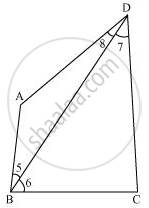
In ΔABD,
AB < AD (AB is the smallest side of quadrilateral ABCD)
∴ ∠8 < ∠5 (Angle opposite to the smaller side is smaller) ... (3)
In ΔBDC,
BC < CD (CD is the largest side of quadrilateral ABCD)
∴ ∠7 < ∠6 (Angle opposite to the smaller side is smaller) ... (4)
On adding equations (3) and (4), we obtain
∠8 + ∠7 < ∠5 + ∠6
⇒ ∠D < ∠B
⇒ ∠B > ∠D
RELATED QUESTIONS
Show that of all line segments drawn from a given point not on it, the perpendicular line segment is the shortest.
In a huge park people are concentrated at three points (see the given figure):

A: where there are different slides and swings for children,
B: near which a man-made lake is situated,
C: which is near to a large parking and exit.
Where should an ice-cream parlour be set up so that maximum number of persons can approach it?
(Hint: The parlor should be equidistant from A, B and C)
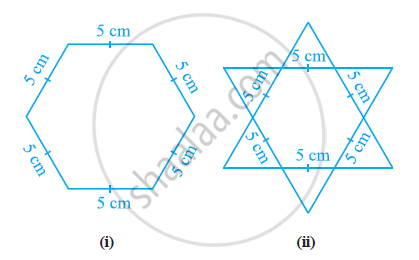
Complete the hexagonal and star shaped rangolies (see the given figures) by filling them with as many equilateral triangles of side 1 cm as you can. Count the number of triangles in each case. Which has more triangles?
From the following figure, prove that: AB > CD.

Name the smallest angle in each of these triangles:
In ΔXYZ, XY = 6.2cm, XY = 6.8cm and YZ = 5cm
In ABC, P, Q and R are points on AB, BC and AC respectively. Prove that AB + BC + AC > PQ + QR + PR.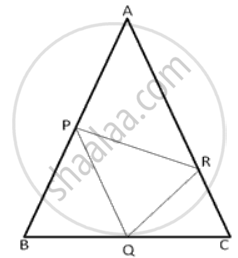
In ΔPQR, PS ⊥ QR ; prove that: PQ + PR > QR and PQ + QR >2PS.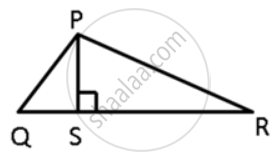
In the given figure, T is a point on the side PR of an equilateral triangle PQR. Show that RT < QT
Prove that in an isosceles triangle any of its equal sides is greater than the straight line joining the vertex to any point on the base of the triangle.
ΔABC in a isosceles triangle with AB = AC. D is a point on BC produced. ED intersects AB at E and AC at F. Prove that AF > AE.