Advertisements
Advertisements
प्रश्न
ABCD is a trapezium. Prove that:
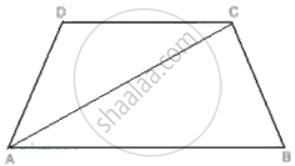
CD + DA + AB + BC > 2AC.
Advertisements
उत्तर
In ΔABC, we have
AB + BC > AC ...(i)
In ΔACD, we have
AD + CD > AC ...(ii)
Adding (i) and (ii), we get
AB + BC + AD + CD > 2AC.
APPEARS IN
संबंधित प्रश्न
In the given figure, ∠B < ∠A and ∠C < ∠D. Show that AD < BC.

In the given figure, PR > PQ and PS bisects ∠QPR. Prove that ∠PSR >∠PSQ.

If two sides of a triangle are 8 cm and 13 cm, then the length of the third side is between a cm and b cm. Find the values of a and b such that a is less than b.
Name the smallest angle in each of these triangles:
In ΔABC, AB = 6.2cm, BC = 5.6cm and AC = 4.2cm
In ΔABC, the exterior ∠PBC > exterior ∠QCB. Prove that AB > AC.
Prove that the hypotenuse is the longest side in a right-angled triangle.
For any quadrilateral, prove that its perimeter is greater than the sum of its diagonals.
ABCD is a quadrilateral in which the diagonals AC and BD intersect at O. Prove that AB + BC + CD + AD < 2(AC + BC).
In ΔABC, BC produced to D, such that, AC = CD; ∠BAD = 125° and ∠ACD = 105°. Show that BC > CD.
Prove that in an isosceles triangle any of its equal sides is greater than the straight line joining the vertex to any point on the base of the triangle.
