Advertisements
Advertisements
प्रश्न
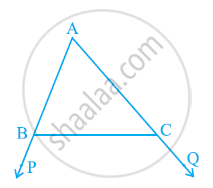
In the given figure sides AB and AC of ΔABC are extended to points P and Q respectively. Also, ∠PBC < ∠QCB. Show that AC > AB.
Advertisements
उत्तर
In the given figure,
∠ABC + ∠PBC = 180° (Linear pair)
⇒ ∠ABC = 180° − ∠PBC ... (1)
Also,
∠ACB + ∠QCB = 180°
∠ACB = 180° − ∠QCB … (2)
As ∠PBC < ∠QCB,
⇒ 180º − ∠PBC > 180º − ∠QCB
⇒ ∠ABC > ∠ACB [From equations (1) and (2)]
⇒ AC > AB (Side opposite to the larger angle is larger.)
संबंधित प्रश्न
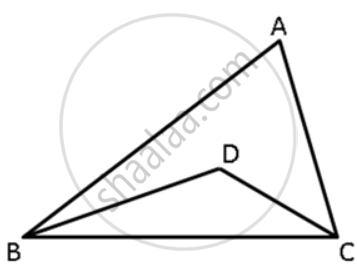
From the following figure, prove that: AB > CD.

In the following figure, ∠BAC = 60o and ∠ABC = 65o.
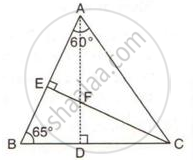
Prove that:
(i) CF > AF
(ii) DC > DF
In the following figure ; AC = CD; ∠BAD = 110o and ∠ACB = 74o.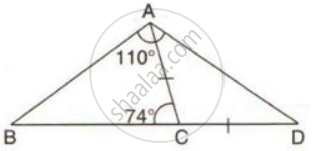
Prove that: BC > CD.
“Caste inequalities are still prevalent in India.” Examine the statement.
Name the greatest and the smallest sides in the following triangles:
ΔABC, ∠ = 56°, ∠B = 64° and ∠C = 60°.
Name the greatest and the smallest sides in the following triangles:
ΔDEF, ∠D = 32°, ∠E = 56° and ∠F = 92°.
Prove that the hypotenuse is the longest side in a right-angled triangle.
In ABC, P, Q and R are points on AB, BC and AC respectively. Prove that AB + BC + AC > PQ + QR + PR.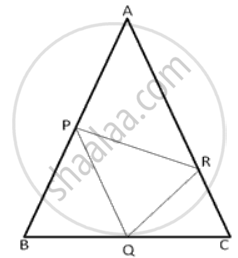
ABCD is a trapezium. Prove that: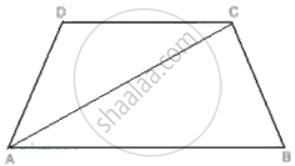
CD + DA + AB + BC > 2AC.
In ΔABC, D is a point in the interior of the triangle. Prove that DB + DC < AB + AC.