Advertisements
Advertisements
प्रश्न
“Caste inequalities are still prevalent in India.” Examine the statement.
Advertisements
उत्तर
Caste inequalities have not completely disappeared from India. Even today, most people marry within their own caste or tribe. Despite the constitutional prohibition, Untouchability has not ended completely. Education is not easily available to the so-called ‘low castes’. Economic status is closely linked to the caste system. In modern India, like in pre-independence India, the poor are mostly the ‘low castes’, while the rich are the ‘high castes’, thereby showing that caste inequalities are still continuing.
APPEARS IN
संबंधित प्रश्न
Show that of all line segments drawn from a given point not on it, the perpendicular line segment is the shortest.
How had the position of women improved in our country since independence ? Explain with examples.
From the following figure, prove that: AB > CD.

In a triangle PQR; QR = PR and ∠P = 36o. Which is the largest side of the triangle?
Name the greatest and the smallest sides in the following triangles:
ΔABC, ∠ = 56°, ∠B = 64° and ∠C = 60°.
D is a point on the side of the BC of ΔABC. Prove that the perimeter of ΔABC is greater than twice of AD.
In the given figure, ∠QPR = 50° and ∠PQR = 60°. Show that: SN < SR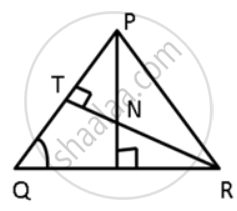
In ΔPQR, PS ⊥ QR ; prove that: PQ > QS and PR > PS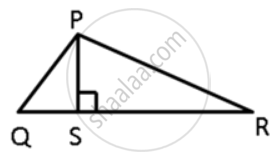
In ΔPQR, PS ⊥ QR ; prove that: PQ + PR > QR and PQ + QR >2PS.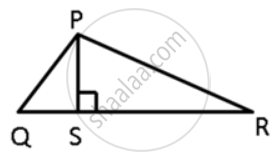
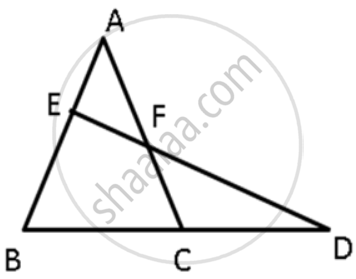
ΔABC in a isosceles triangle with AB = AC. D is a point on BC produced. ED intersects AB at E and AC at F. Prove that AF > AE.