Advertisements
Advertisements
प्रश्न
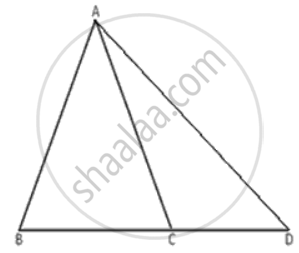
ΔABC is isosceles with AB = AC. If BC is extended to D, then prove that AD > AB.
Advertisements
उत्तर
Using the exterior angle and property in ΔACD, we have
∠ACB = ∠CDA + ∠CAD
⇒ ∠ACB > ∠CDA ------(1)
Now, AB = AC
Now, ∠ACB = ∠ABC ------(2)
From (1) and (2)
∠ABC > ∠CDA
It is known that, in a triangle, the greater angle has the longer side opposite to it.
Now, In ΔABD, er have ∠ABC > ∠CDA
∴ AD > AB.
APPEARS IN
संबंधित प्रश्न
AB and CD are respectively the smallest and longest sides of a quadrilateral ABCD (see the given figure). Show that ∠A > ∠C and ∠B > ∠D.

If two sides of a triangle are 8 cm and 13 cm, then the length of the third side is between a cm and b cm. Find the values of a and b such that a is less than b.
In the following figure, write BC, AC, and CD in ascending order of their lengths.
“Caste inequalities are still prevalent in India.” Examine the statement.
Arrange the sides of the following triangles in an ascending order:
ΔDEF, ∠D = 38°, ∠E = 58°.
In ΔABC, the exterior ∠PBC > exterior ∠QCB. Prove that AB > AC.
D is a point on the side of the BC of ΔABC. Prove that the perimeter of ΔABC is greater than twice of AD.
In ABC, P, Q and R are points on AB, BC and AC respectively. Prove that AB + BC + AC > PQ + QR + PR.
In the given figure, ∠QPR = 50° and ∠PQR = 60°. Show that: SN < SR
In ΔPQR, PS ⊥ QR ; prove that: PQ + PR > QR and PQ + QR >2PS.
